


Keel-billed Motmot
Electron carinatum
Silhouette: Sofía Terán Sánchez · PhyloPic
- KingdomAnimalia (Animals)
- PhylumChordata (Chordates)
- ClassAves (Birds)
- OrderCoraciiformes (Rollers, Kingfishers, and Allies)
- FamilyMomotidae (Motmots)
- GenusElectron (Wide-billed Motmots)
- SpeciesElectron carinatum (Keel-billed Motmot)
About the Keel-billed Motmot
The keel-billed motmot (Electron carinatum) is a Vulnerable species of bird in the motmot family Momotidae. It is found in Belize, Costa Rica, Guatemala, Honduras, Mexico, and Nicaragua. The keel-billed motmot was formally described as Pionites carinatus. It was later referred to as Prionirhynchus carinatus but eventually was renamed Electron carinatum.
The keel-billed motmot is thought to be closely related to the broad-billed motmot (E. platyrhynchum); they are the only members of the genus Electron. The two may be conspecific. Their plumage is very different but their structure and vocalizations are very similar.
The keel-billed motmot is monotypic. The keel-billed motmot is 30.5 to 38 cm (12 to 15 in) long; one male weighed 65 g (2.3 oz). It is a smallish member of the motmot family. The sexes have the same plumage. Adults have a rufus forehead and a black "mask" with a turquoise-blue arc above it on an otherwise green face. Their upper parts are also green. Their chin is pale turquoise. Their underparts are mostly rufous in the northern part of their range becoming greenish to greenish cinnamon in the south. Their chest has a black... Wikipedia →
Recent sightings of Keel-billed Motmot in Braulio Carrillo National Park
LIVEiNaturalistClosest Relatives at Braulio Carrillo National Park

 Broad-billed Motmot
Electron platyrhynchum

Rufous Motmot
Baryphthengus martii

 Lesson's Motmot
Momotus lessonii

Turquoise-browed Motmot
Eumomota superciliosa

 Amazon Kingfisher
Chloroceryle amazona

Green Kingfisher
Chloroceryle americana

 Ringed Kingfisher
Megaceryle torquata

American Pygmy Kingfisher
Chloroceryle aenea

Belted Kingfisher
Megaceryle alcyon
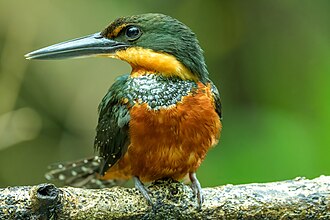
Green-and-rufous Kingfisher
Chloroceryle inda
Global Distribution
Warmer areas are where this animal is recorded most often.
Parks Where Found
| # | Park | Country | Daily sighting probability |
|---|---|---|---|
| 1 | Cerro Azul Meámbar National Park | 🇭🇳 Honduras | |
| 2 | Pico Bonito National Park | 🇭🇳 Honduras | |
| 3 | Tenorio Volcano National Park | 🇨🇷 Costa Rica | |
| 4 | Arenal Volcano National Park | 🇨🇷 Costa Rica | |
| 5 | Braulio Carrillo National Park | 🇨🇷 Costa Rica | |
| 6 | Cockscomb Basin Wildlife Sanctuary | 🇧🇿 Belize | |
| 7 | Monteverde Cloud Forest Reserve | 🇨🇷 Costa Rica | |
| 8 | Corcovado National Park | 🇨🇷 Costa Rica | |
| 9 | Cusuco National Park | 🇭🇳 Honduras | |
| 10 | Lago de Yojoa | 🇭🇳 Honduras | |
| 11 | Rincón de la Vieja National Park | 🇨🇷 Costa Rica |
Quick answers
What are the chances of seeing a Keel-billed Motmot in Braulio Carrillo National Park?
Under 5% of wildlife watchers report a Keel-billed Motmot sighting in Braulio Carrillo National Park, based on 67 verified sightings from GBIF citizen-science data.
When is the best time to see Keel-billed Motmot in Braulio Carrillo National Park?
August has the highest sighting rate for Keel-billed Motmot in Braulio Carrillo National Park in our monthly data.