



Ringed Kingfisher
Megaceryle torquata
Silhouette: Andy Wilson · PhyloPic
- KingdomAnimalia (Animals)
- PhylumChordata (Chordates)
- ClassAves (Birds)
- OrderCoraciiformes (Rollers, Kingfishers, and Allies)
- FamilyAlcedinidae (Kingfishers)
- GenusMegaceryle (Large Crested Kingfishers)
- SpeciesMegaceryle torquata (Ringed Kingfisher)
About the Ringed Kingfisher
The ringed kingfisher (Megaceryle torquata) is a large, conspicuous, and noisy kingfisher bird commonly found along the lower Rio Grande Valley in southeasternmost Texas in the United States through Central America to Tierra del Fuego in South America.
Megaceryle torquata is a Neotropical kingfisher that lives in habitats ranging between the US and Mexico. In 1888, the species was first discovered in the US, while the first ringed kingfisher nest was found in 1970. They are commonly seen along the Rio Grande and in water bodies in southern Texas. Their distribution is increasing and expanding northwards.
The wings of adult males range between 184.9 and 211.1 mm (7.28 and 8.31 in), with an average of 196.3 mm (7.73 in). Their tails range from 110.0–129.0 mm (4.33–5.08 in), and their bills measure 74.9–94 mm (2.95–3.70 in). Female wings are from 185.0-210.1 mm, and their tails measure 111.5–132.1 mm (4.39–5.20 in) and possess bills measuring 75.9–90.9 mm (2.99–3.58 in). Individuals can weigh between 305 and 341 g (10.8 and 12.0 oz). Such measurements prove that the species do not differ sexually in terms of size.
Ringed kingfishers... Wikipedia →
Recent sightings of Ringed Kingfisher in Braulio Carrillo National Park
LIVEiNaturalistClosest Relatives at Braulio Carrillo National Park

 Belted Kingfisher
Megaceryle alcyon

 Amazon Kingfisher
Chloroceryle amazona

Green Kingfisher
Chloroceryle americana

American Pygmy Kingfisher
Chloroceryle aenea
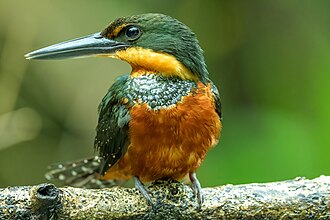
Green-and-rufous Kingfisher
Chloroceryle inda

 Broad-billed Motmot
Electron platyrhynchum

Rufous Motmot
Baryphthengus martii

 Lesson's Motmot
Momotus lessonii

Keel-billed Motmot
Electron carinatum

Turquoise-browed Motmot
Eumomota superciliosa
Global Distribution
Warmer areas are where this animal is recorded most often.
Parks Where Found
Quick answers
What are the chances of seeing a Ringed Kingfisher in Braulio Carrillo National Park?
About 10% of wildlife watchers report a Ringed Kingfisher sighting in Braulio Carrillo National Park, based on 586 verified sightings from GBIF citizen-science data.
When is the best time to see Ringed Kingfisher in Braulio Carrillo National Park?
September has the highest sighting rate for Ringed Kingfisher in Braulio Carrillo National Park in our monthly data.