


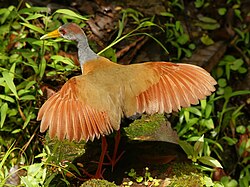


Russet-naped Wood-Rail
Aramides albiventris
Silhouette: Sheatherius · PhyloPic
- KingdomAnimalia (Animals)
- PhylumChordata (Chordates)
- ClassAves (Birds)
- OrderGruiformes (Cranes, Rails, and Allies)
- FamilyRallidae (Rails, Gallinules, and Coots)
- GenusAramides (Neotropical Wood-Rails)
- SpeciesAramides albiventris (Russet-naped Wood-Rail)
About the Russet-naped Wood-Rail
The russet-naped wood rail or rufous-naped wood rail (Aramides albiventris) is a species of bird in the subfamily Rallinae of the rail, crake, and coot family Rallidae. It is found from Mexico to Costa Rica. The russet-naped wood rail was originally described as a species but in the early 20th century was reclassified as a subspecies of what was then called the gray-necked wood rail (Aramides cajanea). A 2015 paper by Marcondes and Silveira proposed reconsidering its position and in 2016 taxonomic systems restored it to species status and renamed the now-reduced A. cajanea the grey-cowled wood rail.
The Clements taxonomy and BirdLife International's Handbook of the Birds of the World follow Marcondes and Silveira in treating the russet-naped wood rail as monotypic. However, the International Ornithological Committee (IOC) assigns it these five subspecies:
A. a. mexicanus Bangs, 1907 A. a. vanrossemi Dickey, 1929 A. a. albiventris Lawrence, 1867 A. a. pacificus A. H. Miller & Griscom, 1921 A. a. plumbeicollis Zeledon, 1888 The russet-naped wood rail is 33 to 40 cm (13 to 16 in) long and weighs about 450 to 600 g (16 to 21 oz). The sexes... Wikipedia →
Recent sightings of Russet-naped Wood-Rail in Cerro Azul Meámbar National Park
LIVEiNaturalistClosest Relatives at Cerro Azul Meámbar National Park

 Common Moorhen
Gallinula chloropus

 American Purple Gallinule
Porphyrio martinica

Ruddy Crake
Laterallus ruber

 American Coot
Fulica americana

Gray-breasted Crake
Laterallus exilis

 Yellow-breasted Crake
Porzana flaviventer

Sora
Porzana carolina

Spotted Rail
Pardirallus maculatus

Uniform Crake
Amaurolimnas concolor

 Limpkin
Aramus guarauna
Global Distribution
Warmer areas are where this animal is recorded most often.