

Rainforest Rocket Frog
Silverstoneia flotator
Silhouette: Steven Traver · PhyloPic
- KingdomAnimalia (Animals)
- PhylumChordata (Chordates)
- ClassAmphibia (Amphibians)
- OrderAnura (Frogs and Toads)
- FamilyDendrobatidae (Poison Dart Frogs)
- GenusSilverstoneia
- SpeciesSilverstoneia flotator (Rainforest Rocket Frog)
About the Rainforest Rocket Frog
Silverstoneia flotator, the rainforest rocket frog, is a terrestrial, diurnal frog found in humid lowlands of Costa Rica and Panama. It is considered to be of least concern by the IUCN. The taxonomy is in need of a review, as it may consist of a complex of several species.
This frog has been observed between 10 and 865 meters above sea level, near rocky-bottomed streams. The frog has been observed in secondary forest, so scientists infer that it may tolerate some habitat disturbance. The female frog lays eggs in leaf litter. After the eggs hatch, the male frog carries the tadpoles to streams.
The IUCN classifies this frog as least concern of extinction because of its large range, large population, and tolerance to habitat disturbance. What threat it faces comes from deforestation associated with agriculture, logging, and urbanization.
Media related to Colostethus flotator at Wikimedia Commons Data related to Silverstoneia flotator at Wikispecies Wikipedia →
Closest Relatives at Chagres National Park
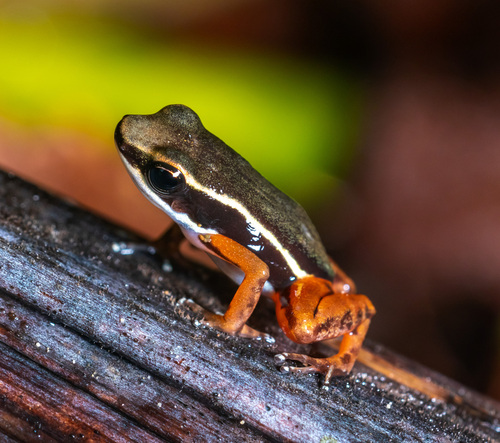
 Boquete Rocket Frog
Silverstoneia nubicola

Green and Black Dart-poison Frog
Dendrobates auratus

Yellow-bellied Poison Frog
Andinobates fulguritus

Panama Rocket Frog
Colostethus panamansis

Blue-bellied Poison Frog
Andinobates minutus

Pratt's Poison Frog
Colostethus pratti

 Giant Marine Toad
Rhinella horribilis
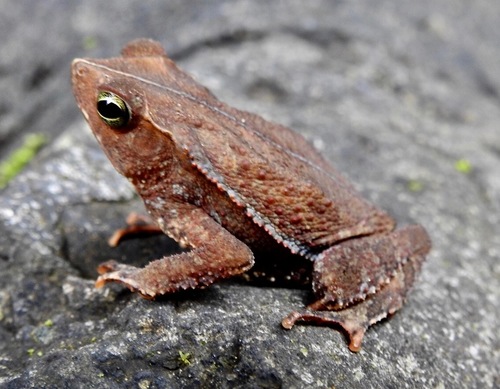
Forest Toad
Rhinella alata

 Masked Tree Frog
Smilisca phaeota

 Leaf Litter Toad
Rhaebo haematiticus

 Guayaquil Dwarf Frog
Engystomops pustulosus

Gaige's Rain Frog
Pristimantis gaigei
Global Distribution
Warmer areas are where this animal is recorded most often.
Parks Where Found
| # | Park | Country | Daily sighting probability |
|---|---|---|---|
| 1 | Piedras Blancas National Park | 🇨🇷 Costa Rica | |
| 2 | Soberanía National Park | 🇵🇦 Panama | |
| 3 | Corcovado National Park | 🇨🇷 Costa Rica | |
| 4 | Gandoca-Manzanillo Wildlife Refuge | 🇨🇷 Costa Rica | |
| 5 | Bastimentos Island National Marine Park | 🇵🇦 Panama | |
| 6 | La Amistad International Park (Panama) | 🇵🇦 Panama | |
| 7 | Chagres National Park | 🇵🇦 Panama | |
| 8 | Darién National Park | 🇵🇦 Panama | |
| 9 | Parque Natural Metropolitano | 🇵🇦 Panama |