

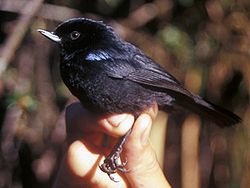



Glossy Flowerpiercer
Diglossa lafresnayii
Silhouette: Sheatherius · PhyloPic
- KingdomAnimalia (Animals)
- PhylumChordata (Chordates)
- ClassAves (Birds)
- OrderPasseriformes (Perching Birds)
- FamilyThraupidae (Tanagers and Allies)
- GenusDiglossa (Flowerpiercers)
- SpeciesDiglossa lafresnayii (Glossy Flowerpiercer)
About the Glossy Flowerpiercer
The glossy flowerpiercer (Diglossa lafresnayii) is a species of bird in the family Thraupidae. It is found in Colombia, Ecuador, Peru, and Venezuela. Its natural habitats are subtropical or tropical moist montane forests, subtropical or tropical high-altitude grassland, and heavily degraded former forest. Wikipedia →
Recent sightings of Glossy Flowerpiercer in Chingaza National Natural Park
LIVEiNaturalistClosest Relatives at Chingaza National Natural Park

 Masked Flowerpiercer
Diglossa cyanea

Black Flowerpiercer
Diglossa humeralis

White-sided Flowerpiercer
Diglossa albilatera

Bluish Flowerpiercer
Diglossa caerulescens

Rusty Flowerpiercer
Diglossa sittoides

Scarlet-bellied Mountain-Tanager
Anisognathus igniventris

Rufous-browed Conebill
Conirostrum rufum

Plumbeous Sierra-Finch
Geospizopsis unicolor

Blue-gray Tanager
Thraupis episcopus

Blue-backed Conebill
Conirostrum sitticolor

 Bananaquit
Coereba flaveola

Hooded Mountain-Tanager
Buthraupis montana
Global Distribution
Warmer areas are where this animal is recorded most often.
Parks Where Found
| # | Park | Country | Daily sighting probability |
|---|---|---|---|
| 1 | Chingaza National Natural Park | 🇨🇴 Colombia | |
| 2 | Los Nevados National Natural Park | 🇨🇴 Colombia | |
| 3 | Podocarpus National Park | 🇪🇨 Ecuador | |
| 4 | Puracé National Natural Park | 🇨🇴 Colombia | |
| 5 | Farallones de Cali National Natural Park | 🇨🇴 Colombia | |
| 6 | Cajas National Park | 🇪🇨 Ecuador |
Quick answers
What are the chances of seeing a Glossy Flowerpiercer in Chingaza National Natural Park?
About 30% of wildlife watchers report a Glossy Flowerpiercer sighting in Chingaza National Natural Park, based on 484 verified sightings from GBIF citizen-science data.
When is the best time to see Glossy Flowerpiercer in Chingaza National Natural Park?
February has the highest sighting rate for Glossy Flowerpiercer in Chingaza National Natural Park in our monthly data.