


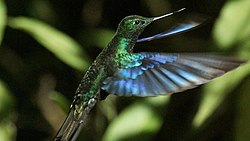


Great Sapphirewing
Pterophanes cyanopterus
Silhouette: Ferran Sayol · PhyloPic
- KingdomAnimalia (Animals)
- PhylumChordata (Chordates)
- ClassAves (Birds)
- OrderApodiformes (Swifts and Hummingbirds)
- FamilyTrochilidae (Hummingbirds)
- GenusPterophanes
- SpeciesPterophanes cyanopterus (Great Sapphirewing)
About the Great Sapphirewing
The great sapphirewing (Pterophanes cyanopterus) is a species of hummingbird in the "brilliants", tribe Heliantheini in subfamily Lesbiinae. It is found in Bolivia, Colombia, Ecuador, and Peru. The great sapphirewing is the only member of its genus. In the late 1900s it was suggested that Pterophanes be merged into genus Coeligena, but later work showed that those genera are not closely related. The species has three subspecies, the nominate P. c. cyanopterus, P. c. caeruleus, and P. c. peruvianus.
The great sapphirewing has also been called Temminck's sapphirewing, páramo sapphirewing, and simply sapphirewing. The great sapphirewing is one of the largest hummingbirds; only the two of genus Topaza and the giant hummingbird (Patagona gigas) are larger. It is 15.5 to 19 cm (6.1 to 7.5 in) long including the 3.6 cm (1.4 in) bill. Males weigh between 9.6 and 11.2 g (0.34 and 0.40 oz) and females 8.4 to 11 g (0.30 to 0.39 oz). Both sexes have a small white spot behind the eye. Males of the nominate subspecies have dark shining blue-green upperparts. The wing is mostly shining blue and the tail greenish black. The underparts are also blue-green... Wikipedia →
Recent sightings of Great Sapphirewing in Chingaza National Natural Park
LIVEiNaturalistClosest Relatives at Chingaza National Natural Park

 Tyrian Metaltail
Metallura tyrianthina

Glowing Puffleg
Eriocnemis vestita

Bronze-tailed Thornbill
Chalcostigma heteropogon

Sparkling Violetear
Colibri coruscans

 Longuemare's Amethyst-throated Sunangel
Heliangelus clarisse

Coppery-bellied Puffleg
Eriocnemis cupreoventris

Lesser Violetear
Colibri cyanotus

Purple-backed Thornbill
Ramphomicron microrhynchum

 Blue-throated Starfrontlet
Coeligena helianthea

Long-tailed Sylph
Aglaiocercus kingii

Green-bellied Hummingbird
Saucerottia viridigaster

 White-booted Racket-tail
Ocreatus underwoodii
Global Distribution
Warmer areas are where this animal is recorded most often.
Parks Where Found
| # | Park | Country | Daily sighting probability |
|---|---|---|---|
| 1 | Los Nevados National Natural Park | 🇨🇴 Colombia | |
| 2 | Chingaza National Natural Park | 🇨🇴 Colombia | |
| 3 | Cajas National Park | 🇪🇨 Ecuador | |
| 4 | Podocarpus National Park | 🇪🇨 Ecuador | |
| 5 | Madidi National Park | 🇧🇴 Bolivia | |
| 6 | Manu National Park | 🇵🇪 Peru | |
| 7 | Puracé National Natural Park | 🇨🇴 Colombia | |
| 8 | Farallones de Cali National Natural Park | 🇨🇴 Colombia |
Quick answers
What are the chances of seeing a Great Sapphirewing in Chingaza National Natural Park?
About 10% of wildlife watchers report a Great Sapphirewing sighting in Chingaza National Natural Park, based on 172 verified sightings from GBIF citizen-science data.
When is the best time to see Great Sapphirewing in Chingaza National Natural Park?
February has the highest sighting rate for Great Sapphirewing in Chingaza National Natural Park in our monthly data.