

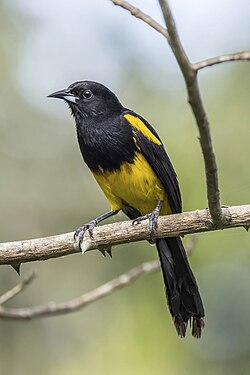



Black-cowled Oriole
Icterus prosthemelas
Silhouette: Matt Wilkins · PhyloPic
- KingdomAnimalia (Animals)
- PhylumChordata (Chordates)
- ClassAves (Birds)
- OrderPasseriformes (Perching Birds)
- FamilyIcteridae (New World Blackbirds and Orioles)
- GenusIcterus (New World Orioles)
- SpeciesIcterus prosthemelas (Black-cowled Oriole)
About the Black-cowled Oriole
The black-cowled oriole (Icterus prosthemelas) is a species of bird in the family Icteridae. It is common and widespread in the Caribbean lowlands and foothills from southern Mexico to western Panama. It lives primarily in humid or semihumid forest, as well as in clearings, along forest edges, in plantations, in semi-open areas with scattered trees and bushes, and in gardens. The adult male is black, with yellow on the belly, shoulder, rump, wing lining, and crissum. The female's plumage varies depending on location. In the south of its range, it is similar to that of the male. In the north, its crown and upperparts are olive-yellow, while its face, throat, upper breast, wings, and tail are black.
It forages mostly at mid-levels, and its diet includes a mix of arthropods, nectar and fruit. The female lays three eggs in a shallow pendent nest, which is stitched to the underside of a large leaf. Both parents defend the nest, and brood and feed the young. Due to its very large range and apparently stable population, it is considered by the International Union for Conservation of Nature to be a species of least concern.
First described by Hugh Strickland in 1850, the black-cowled oriole has at times been considered conspecific with several oriole species from the Greater Antilles. There are two subspecies, I. p. prosthemelas and I. p. praecox, which differ in their juvenile plumage. Wikipedia →
Recent sightings of Black-cowled Oriole in Cockscomb Basin Wildlife Sanctuary
LIVEiNaturalistClosest Relatives at Cockscomb Basin Wildlife Sanctuary

 Baltimore Oriole
Icterus galbula

Yellow-tailed Oriole
Icterus mesomelas

Orchard Oriole
Icterus spurius

Hooded Oriole
Icterus cucullatus

Yellow-backed Oriole
Icterus chrysater

 Melodious Blackbird
Dives dives

Yellow-billed Cacique
Amblycercus holosericeus

Montezuma Oropendola
Psarocolius montezuma

 Great-tailed Grackle
Quiscalus mexicanus

Chestnut-headed Oropendola
Psarocolius wagleri

 Bronzed Cowbird
Molothrus aeneus

Giant Cowbird
Molothrus oryzivorus
Global Distribution
Warmer areas are where this animal is recorded most often.
Parks Where Found
Quick answers
What are the chances of seeing a Black-cowled Oriole in Cockscomb Basin Wildlife Sanctuary?
About 30% of wildlife watchers report a Black-cowled Oriole sighting in Cockscomb Basin Wildlife Sanctuary, based on 358 verified sightings from GBIF citizen-science data.
When is the best time to see Black-cowled Oriole in Cockscomb Basin Wildlife Sanctuary?
April has the highest sighting rate for Black-cowled Oriole in Cockscomb Basin Wildlife Sanctuary in our monthly data.