

fringe-lipped bat
Trachops cirrhosus
Silhouette: Melissa Ingala · PhyloPic
- KingdomAnimalia (Animals)
- PhylumChordata (Chordates)
- ClassMammalia (Mammals)
- OrderChiroptera (Bats)
- FamilyPhyllostomidae (New World Leaf-nosed Bats)
- GenusTrachops (Fringe-lipped Bats)
- SpeciesTrachops cirrhosus (fringe-lipped bat)
About the fringe-lipped bat
The fringe-lipped bat (Trachops cirrhosus) is a leaf-nosed bat from southern Mexico to Bolivia and southern Brazil. It has three subspecies and no known fossils. It is the only species within its genus. The fringe-lipped bat has wart-like bumps on its lips and muzzle, which give it its name. The bat has an overall color of a reddish brown with gray on its belly. The fur is long and woolly. It is medium in size, about 32 grams.
The tail is short. It has a nose-leaf with serrated edges. It has two pairs of lower incisors with three pairs of lower premolars. The molars have tubercular depressions with w-shaped cusps. The rostrum is shorter than the braincase but equal to the width of the braincase. It has a low wing-aspect ratio and high wing loading.
The fringe-lipped bat generally mates during the dry season in the tropics, usually from January to June. There is no real difference in appearance between the male and the female. It gives birth to one offspring at a time. The young can stay with the parents for a considerable amount of time.
Its preferred habitat is near ponds or streams. It roosts in trees or hollow logs... Wikipedia →
Recent sightings of fringe-lipped bat in Cuyabeno Wildlife Reserve
LIVEiNaturalistClosest Relatives at Cuyabeno Wildlife Reserve

 Greater Spear-nosed Bat
Phyllostomus hastatus
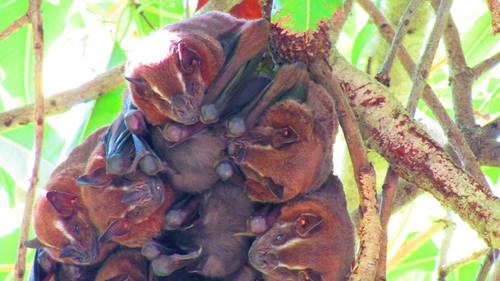
 Great Fruit-eating Bat
Artibeus lituratus

MacConnell's bat
Mesophylla macconnelli

Bidentate Yellow-eared Bat
Vampyriscus bidens

Northern Little Yellow-eared Bat
Vampyressa thyone

Fischer's little fruit bat
Rhinophylla fischerae

Striped Spearnosed Bat
Gardnerycteris crenulatum

Dark Fruit-eating Bat
Artibeus obscurus
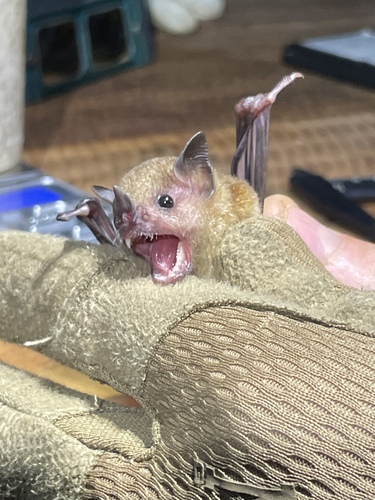
Gianna's Yellow-shouldered Bat
Sturnira giannae

Andersen's Fruit-eating Bat
Artibeus anderseni

Silky Short-Tailed Bat
Carollia brevicaudum

Pygmy Round-eared Bat
Lophostoma brasiliense
Global Distribution
Warmer areas are where this animal is recorded most often.
Parks Where Found
| # | Park | Country | Daily sighting probability |
|---|---|---|---|
| 1 | Soberanía National Park | 🇵🇦 Panama | |
| 2 | Palo Verde National Park | 🇨🇷 Costa Rica | |
| 3 | Sierra de la Macarena National Park | 🇨🇴 Colombia | |
| 4 | Cabo Blanco Absolute Nature Reserve | 🇨🇷 Costa Rica | |
| 5 | Calakmul Biosphere Reserve | 🇲🇽 Mexico | |
| 6 | Montes Azules Biosphere Reserve | 🇲🇽 Mexico | |
| 7 | Parque Estadual Encontro das Águas | 🇧🇷 Brazil | |
| 8 | Bastimentos Island National Marine Park | 🇵🇦 Panama | |
| 9 | Tambopata National Reserve | 🇵🇪 Peru | |
| 10 | Braulio Carrillo National Park | 🇨🇷 Costa Rica | |
| 11 | Cuyabeno Wildlife Reserve | 🇪🇨 Ecuador | |
| 12 | Corcovado National Park | 🇨🇷 Costa Rica | |
| 13 | Manu National Park | 🇵🇪 Peru | |
| 14 | La Amistad International Park (Panama) | 🇵🇦 Panama |