


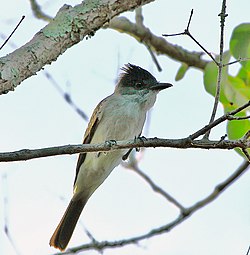
Sibilant Sirystes
Sirystes sibilator
Silhouette: Emily Willoughby · PhyloPic
- KingdomAnimalia (Animals)
- PhylumChordata (Chordates)
- ClassAves (Birds)
- OrderPasseriformes (Perching Birds)
- FamilyTyrannidae (Tyrant Flycatchers)
- GenusSirystes
- SpeciesSirystes sibilator (Sibilant Sirystes)
About the Sibilant Sirystes
The sibilant sirystes (Sirystes sibilator) is a species of bird in the family Tyrannidae, the tyrant flycatchers. It is found in Argentina, Bolivia, Brazil, and Paraguay. The sibilant sirystes was originally described as Muscicapa sibilator, mistakenly placing it with the Old World flycatchers. In 1860 the genus Sirystes was erected for it. Some authors included the genus in family Cotingidae but by the 1930s it was placed in its current family. The sibilant sirystes was eventually expanded by what are now the white-rumped sirystes (S. albocinereus) and Todd's sirystes (S. subcanescens); some systems also included what is now the Choco sirystes (S. albogriseus). The combined species was simply called "sirystes". As a result of a study published in 2013, "sirystes" was split into four species.
The sibilant sirystes has two subspecies, the nominate S. s. sibilator (Vieillot, 1818) and S. s. atimastus (Oberholser, 1902). The sibilant sirystes is 18 to 18.5 cm (7.1 to 7.3 in) long and weighs about 26 to 28 g (0.92 to 0.99 oz). The sexes have the same plumage. Adults of the nominate subspecies have a black crown with a slight crest. The rest... Wikipedia →
Recent sightings of Sibilant Sirystes in Iguaçu National Park
LIVEiNaturalistClosest Relatives at Iguaçu National Park

 Great Kiskadee
Pitangus sulphuratus

 Social Flycatcher
Myiozetetes similis

Boat-billed Flycatcher
Megarynchus pitangua

Southern Antpipit
Corythopis delalandi

 Tropical Kingbird
Tyrannus melancholicus

Eared Pygmy-Tyrant
Myiornis auricularis

Sepia-capped Flycatcher
Leptopogon amaurocephalus

Yellow Tyrannulet
Capsiempis flaveola

Cattle Tyrant
Machetornis rixosa

Southern Beardless-Tyrannulet
Camptostoma obsoletum

 Short-crested Flycatcher
Myiarchus ferox

Fork-tailed Flycatcher
Tyrannus savana
Global Distribution
Warmer areas are where this animal is recorded most often.
Parks Where Found
| # | Park | Country | Daily sighting probability |
|---|---|---|---|
| 1 | Itatiaia National Park | 🇧🇷 Brazil | |
| 2 | Iguazú National Park | 🇦🇷 Argentina | |
| 3 | Iguaçu National Park | 🇧🇷 Brazil | |
| 4 | Chapada dos Guimarães National Park | 🇧🇷 Brazil | |
| 5 | Darién National Park | 🇵🇦 Panama | |
| 6 | Serra da Canastra National Park | 🇧🇷 Brazil | |
| 7 | Chapada Diamantina National Park | 🇧🇷 Brazil | |
| 8 | Emas National Park | 🇧🇷 Brazil | |
| 9 | Utría National Natural Park | 🇨🇴 Colombia | |
| 10 | Chagres National Park | 🇵🇦 Panama | |
| 11 | Parque Estadual Encontro das Águas | 🇧🇷 Brazil | |
| 12 | Soberanía National Park | 🇵🇦 Panama |
Quick answers
What are the chances of seeing a Sibilant Sirystes in Iguaçu National Park?
About 20% of wildlife watchers report a Sibilant Sirystes sighting in Iguaçu National Park, based on 804 verified sightings from GBIF citizen-science data.
When is the best time to see Sibilant Sirystes in Iguaçu National Park?
May has the highest sighting rate for Sibilant Sirystes in Iguaçu National Park in our monthly data.