

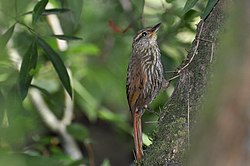


Buff-browed Foliage-gleaner
Syndactyla rufosuperciliata
Silhouette: Sheatherius · PhyloPic
- KingdomAnimalia (Animals)
- PhylumChordata (Chordates)
- ClassAves (Birds)
- OrderPasseriformes (Perching Birds)
- FamilyFurnariidae (Ovenbirds and Woodcreepers)
- GenusSyndactyla (Syndactyla Foliage-gleaners)
- SpeciesSyndactyla rufosuperciliata (Buff-browed Foliage-gleaner)
About the Buff-browed Foliage-gleaner
The buff-browed foliage-gleaner (Syndactyla rufosuperciliata) is a species of bird in the Furnariinae subfamily of the ovenbird family Furnariidae. It is found in Argentina, Bolivia, Brazil, Ecuador, Paraguay, Peru, and Uruguay.
The buff-browed foliage-gleaner's taxonomy is unsettled. The International Ornithological Committee and BirdLife International's Handbook of the Birds of the World recognize these four subspecies: S. r. cabanisi (Taczanowski, 1875)
S. r. oleaginea (Sclater, PL, 1884) S. r. rufosuperciliata (Lafresnaye, 1832) S. r. acrita (Oberholser, 1901) The Clements taxonomy adds a fifth, S. r. similis (Chapman, 1927) that the other two systems include within S. r. cabanisi. This article follows the four-subspecies model.
DNA sequencing data identified two major genetic groups: one in the Andes (subspecies S. r. cabanisi and S. r. oleaginea), and the other in the Atlantic Forest (subspecies S. r. rufosuperciliata and S. r. acrita), suggesting that they might be treated as two separate species. In the Atlantic Forest, subspecies S. r. rufosuperciliata and S. r. acrita were genetically differentiated, but in the Andes, genetic variation did not... Wikipedia →
Recent sightings of Buff-browed Foliage-gleaner in El Palmar National Park
LIVEiNaturalistClosest Relatives at El Palmar National Park

 Rufous Hornero
Furnarius rufus

 Sooty-fronted Spinetail
Synallaxis frontalis

Narrow-billed Woodcreeper
Lepidocolaptes angustirostris

Stripe-crowned Spinetail
Cranioleuca pyrrhophia

Firewood-gatherer
Anumbius annumbi

Freckle-breasted Thornbird
Phacellodomus striaticollis

Pale-breasted Spinetail
Synallaxis albescens

Chotoy Spinetail
Schoeniophylax phryganophilus

Wren-like Rushbird
Phleocryptes melanops

Brown Cacholote
Pseudoseisura lophotes

Little Thornbird
Phacellodomus sibilatrix

Yellow-chinned Spinetail
Certhiaxis cinnamomeus
Global Distribution
Warmer areas are where this animal is recorded most often.
Parks Where Found
| # | Park | Country | Daily sighting probability |
|---|---|---|---|
| 1 | El Palmar National Park | 🇦🇷 Argentina | |
| 2 | Itatiaia National Park | 🇧🇷 Brazil | |
| 3 | Serra dos Órgãos National Park | 🇧🇷 Brazil | |
| 4 | Amboró National Park | 🇧🇴 Bolivia | |
| 5 | Cordillera Azul National Park | 🇵🇪 Peru | |
| 6 | Iguaçu National Park | 🇧🇷 Brazil | |
| 7 | Iguazú National Park | 🇦🇷 Argentina | |
| 8 | Madidi National Park | 🇧🇴 Bolivia | |
| 9 | Iberá National Park | 🇦🇷 Argentina | |
| 10 | Podocarpus National Park | 🇪🇨 Ecuador |
Quick answers
What are the chances of seeing a Buff-browed Foliage-gleaner in El Palmar National Park?
About 30% of wildlife watchers report a Buff-browed Foliage-gleaner sighting in El Palmar National Park, based on 94 verified sightings from GBIF citizen-science data.
When is the best time to see Buff-browed Foliage-gleaner in El Palmar National Park?
December has the highest sighting rate for Buff-browed Foliage-gleaner in El Palmar National Park in our monthly data.