



Ragged Snake-eyed Skink
Cryptoblepharus pannosus
Silhouette: David Orr · PhyloPic
- KingdomAnimalia (Animals)
- PhylumChordata (Chordates)
- ClassSquamata
- FamilyScincidae (Skinks)
- GenusCryptoblepharus (Snake-eyed Skinks)
- SpeciesCryptoblepharus pannosus (Ragged Snake-eyed Skink)
About the Ragged Snake-eyed Skink
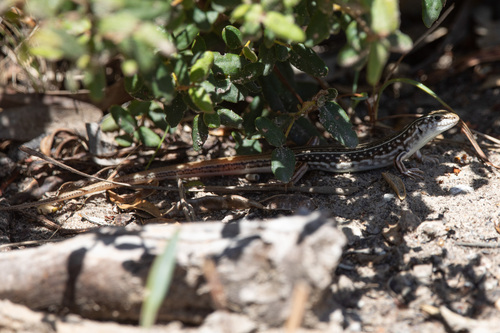
Cryptoblepharus pannosus, also known commonly as the ragged snake-eyed skink, is a species of lizard in the family Scincidae. The species is endemic to Australia. Within Australia, C. pannosus is found in New South Wales, Northern Territory, Queensland, South Australia, Victoria and the Australian Capital Territory.
C. pannosus are very agile climbers, and because of this they are mainly arboreal and extremely versatile, they can be found living under rocks and logs. C. pannosus can also live in or under human structures, including fences and walls throughout Eastern Australia. C. pannosus also occur in a variety of habitats, including forest, shrubland, and grassland.
Medium-sized for its genus and short-legged for its genus, as an adult C. pannosus has a snout-to-vent length (SVL) of 4.0–4.4 cm (1.6–1.7 in). C. pannosus has a longitudinally-aligned pattern, with usually 5 supraciliary scales, pale, acute plantar scales, strongly keeled sub digital lamellae, 43–56 (modally 48) paravertebral scales, and relatively short limbs.
Brown, grey to blackish with variable, complex ragged pattern including broad dark vertebral zone 3–4 scales... Wikipedia →
Recent sightings of Ragged Snake-eyed Skink in Flinders Ranges National Park
LIVEiNaturalistClosest Relatives at Flinders Ranges National Park

 Shiny-palmed Shining-skink
Cryptoblepharus australis

Shingleback Lizard
Tiliqua rugosa

Flinder's Ranges Rock-skink
Liopholis personata

 Tree Skink
Egernia striolata

Boulenger's Snake-eyed Skink
Morethia boulengeri

Gidgee Skink
Egernia stokesii

Eastern Striped Skink
Ctenotus robustus

 Broad Banded Sand Swimmer
Eremiascincus richardsonii

Common Dwarf Skink
Menetia greyii

Common Bluetongue
Tiliqua scincoides
Oriental Ctenotus
Ctenotus orientalis
Global Distribution
Warmer areas are where this animal is recorded most often.
Parks Where Found
| # | Park | Country | Daily sighting probability |
|---|---|---|---|
| 1 | Grampians National Park | 🇦🇺 Australia | |
| 2 | Flinders Ranges National Park | 🇦🇺 Australia |
Quick answers
What are the chances of seeing a Ragged Snake-eyed Skink in Flinders Ranges National Park?
About 20% of wildlife watchers report a Ragged Snake-eyed Skink sighting in Flinders Ranges National Park, based on 8 verified sightings from GBIF citizen-science data.
When is the best time to see Ragged Snake-eyed Skink in Flinders Ranges National Park?
September has the highest sighting rate for Ragged Snake-eyed Skink in Flinders Ranges National Park in our monthly data.