



Tree Skink
Egernia striolata
Silhouette: Kailah Thorn & Ben King · PhyloPic
- KingdomAnimalia (Animals)
- PhylumChordata (Chordates)
- ClassSquamata
- FamilyScincidae (Skinks)
- GenusEgernia (Spiny-tailed and Crevice Skinks)
- SpeciesEgernia striolata (Tree Skink)
About the Tree Skink
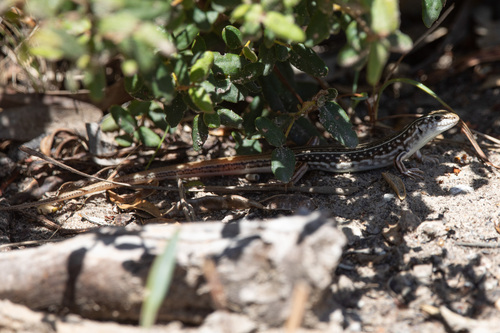
The tree-crevice skink or tree skink (Egernia striolata) is a species of skink, a lizard in the family Scincidae. The species is endemic to Australia and is found in the states of Victoria, the Northern Territory, Queensland, New South Wales and South Australia. E. striolata tend to live in crevices and cracks in hollow logs or rocks. They greatly prefer heterogeneous and structurally diverse habitats and their behavior changes depending on the habitat they live in.
They are moderately large lizards of the genus Egernia and are generally colored dark-black to grey-brown with a pale stripe going from their head to their tail. They grow to be around 100–118 mm long and can live for up to ten years. Their primary diet consists of larger, hard-bodied insects. Snakes, birds, and mammals are their major predators.
They are well known for their complex social interactions and their ability to flexibly adjust their behavior depending on environmental factors. They generally live in small nuclear family groups of 2-10 individuals, made up of parents and their offspring. Offspring stay with their parents in these units until they fully mature, after which they will disperse. They mate monogamously and can live with up to several generations of their offspring at a time. The unique ability of E. striolata to chemically identify their kin and quickly react to novel social situations allows them to live in multi-generational family units. They almost always prefer to live in groups over individually. Even when there are multiple unoccupied habitats well-suited to an individual's needs, E. striolata still opts to live in groups over living alone. E. striolata are highly territorial and mark their territory using scat. E. striolata acts more aggressively or cautiously around individuals that are not identified to be family members. Wikipedia →
Recent sightings of Tree Skink in Flinders Ranges National Park
LIVEiNaturalistClosest Relatives at Flinders Ranges National Park

 Gidgee Skink
Egernia stokesii

 Shingleback Lizard
Tiliqua rugosa

Flinder's Ranges Rock-skink
Liopholis personata

Boulenger's Snake-eyed Skink
Morethia boulengeri

Eastern Striped Skink
Ctenotus robustus

Ragged Snake-eyed Skink
Cryptoblepharus pannosus

 Broad Banded Sand Swimmer
Eremiascincus richardsonii

Common Dwarf Skink
Menetia greyii

Shiny-palmed Shining-skink
Cryptoblepharus australis

Common Bluetongue
Tiliqua scincoides
Oriental Ctenotus
Ctenotus orientalis
Global Distribution
Warmer areas are where this animal is recorded most often.
Parks Where Found
| # | Park | Country | Daily sighting probability |
|---|---|---|---|
| 1 | Flinders Ranges National Park | 🇦🇺 Australia |
More parks will be added in future updates.
Quick answers
What are the chances of seeing a Tree Skink in Flinders Ranges National Park?
About 40% of wildlife watchers report a Tree Skink sighting in Flinders Ranges National Park, based on 36 verified sightings from GBIF citizen-science data.
When is the best time to see Tree Skink in Flinders Ranges National Park?
October has the highest sighting rate for Tree Skink in Flinders Ranges National Park in our monthly data.