


Many-lined Sun-skink
Eutropis multifasciata
- KingdomAnimalia (Animals)
- PhylumChordata (Chordates)
- ClassSquamata
- FamilyScincidae (Skinks)
- GenusEutropis (Asian Mabuyas)
- SpeciesEutropis multifasciata (Many-lined Sun-skink)
About the Many-lined Sun-skink
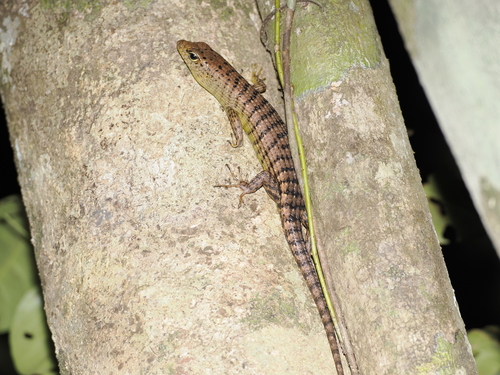
Eutropis multifasciata, commonly known as the East Indian brown mabuya, many-lined sun skink, many-striped skink, common sun skink or (ambiguously) as golden skink, is a species of skink that inhabits an extensive range from India and southern China to southern Indonesia.
See Snake scales for terminology. Eutropis multifasciata is a species of skink that often shows prominent coloured dorsal bands. They have a number of other distinctive features that allows this species to be distinguished from other species, particularly in the detail of the arrangement of their scales. Their snout is moderate to obtuse, and their lower eyelid is scaly. The nostril is positioned behind the vertical line of the suture between the rostral and first labial scale, and it has a postnasal scale. The anterior loreal scale is no deeper than the second, and is in contact with the first labial scale. The supranasal scales are largely in contact behind the rostral. The frontonasal scale is broader than it is long, and the prefrontal scales consistently form a median suture. The frontal scale is as long as or shorter than the frontoparietals and interparietal together, and makes contact with... Wikipedia →
Closest Relatives at Gunung Leuser National Park




Global Distribution
Where this species is recorded worldwide. Restricted to human observations from 2019 onwards — the same kind of record and the same period the probabilities on this page are built from, so collar-tracking studies, camera-trap arrays and museum specimens are excluded. Around Santa Rosa that removes 5,924 GPS fixes from a handful of tagged jaguars.
where this species is recorded (GBIF density — it tracks where observers go, not how likely a sighting is) · parks where it occurs — tap a pin for the sighting probability there
Parks Where Found
| # | Park | Country | Daily sighting probability |
|---|---|---|---|
| 1 | Bali Barat National Park | 🇮🇩 Indonesia | |
| 2 | Cat Tien National Park | 🇻🇳 Vietnam | |
| 3 | Khao Sok National Park | 🇹🇭 Thailand | |
| 4 | Khao Luang National Park | 🇹🇭 Thailand | |
| 5 | Gunung Leuser National Park | 🇮🇩 Indonesia | |
| 6 | Kerinci Seblat National Park | 🇮🇩 Indonesia | |
| 7 | Bako National Park | 🇲🇾 Malaysia | |
| 8 | Khao Yai National Park | 🇹🇭 Thailand | |
| 9 | Taman Negara National Park | 🇲🇾 Malaysia | |
| 10 | Kaeng Krachan National Park | 🇹🇭 Thailand | |
| 11 | Doi Inthanon National Park | 🇹🇭 Thailand | |
| 12 | Sepilok | 🇲🇾 Malaysia | |
| 13 | Raja Ampat | 🇮🇩 Indonesia | |
| 14 | Tanjung Puting National Park | 🇮🇩 Indonesia | |
| 15 | Cuc Phuong National Park | 🇻🇳 Vietnam | |
| 16 | Way Kambas National Park | 🇮🇩 Indonesia | |
| 17 | Kaziranga National Park | 🇮🇳 India | |
| 18 | Kinabalu Park | 🇲🇾 Malaysia | |
| 19 | Danum Valley Conservation Area | 🇲🇾 Malaysia | |
| 20 | Kinabatangan Wildlife Sanctuary | 🇲🇾 Malaysia |
Quick answers
What are the chances of seeing a Many-lined Sun-skink in Gunung Leuser National Park?
About 40% of wildlife watchers report a Many-lined Sun-skink sighting in Gunung Leuser National Park, based on 44 verified sightings from GBIF citizen-science data.
When is the best time to see Many-lined Sun-skink in Gunung Leuser National Park?
October has the highest sighting rate for Many-lined Sun-skink in Gunung Leuser National Park in our monthly data.