


Blue-billed Black-Tyrant
Knipolegus cyanirostris
Silhouette: Emily Willoughby · PhyloPic
- KingdomAnimalia (Animals)
- PhylumChordata (Chordates)
- ClassAves (Birds)
- OrderPasseriformes (Perching Birds)
- FamilyTyrannidae (Tyrant Flycatchers)
- GenusKnipolegus (Black-Tyrants)
- SpeciesKnipolegus cyanirostris (Blue-billed Black-Tyrant)
About the Blue-billed Black-Tyrant
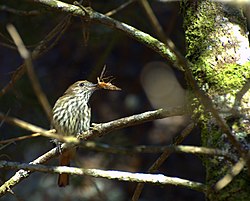
The blue-billed black tyrant (Knipolegus cyanirostris) is a species of bird in the family Tyrannidae, the tyrant flycatchers. It is found in Argentina, Brazil, Paraguay, and Uruguay. The blue-billed black tyrant was formally described in 1818 as Muscicapa cyanirostris, placing it in the Old World flycatcher family. It was later transferred to genus Knipolegus, which was erected in 1826 with it as the type species.
The blue-billed black tyrant is monotypic. The blue-billed black tyrant is 14.5 to 15 cm (5.7 to 5.9 in) long. Adult males are almost entirely glossy black but for faint white edges on the underside of their remiges. Adult females have mostly rufous-brown upperparts. Their crown is a brighter rufous, their rump rufous, and their tail coverts bright cinnamon. Their wings are blackish with buff to cinnamon edges on the coverts that show as two wing bars. Their tail is dusky with rufous edges to the feathers. Their underparts are mostly whitish to yellowish white with heavy blackish brown streaks and their crissum is cinnamon-rufous. Males have a bright red iris, a pale blue bill with a black tip, and black legs and feet. Females... Wikipedia →
Recent sightings of Blue-billed Black-Tyrant in Itatiaia National Park
LIVEiNaturalistClosest Relatives at Itatiaia National Park

 Velvety Black-Tyrant
Knipolegus nigerrimus

Crested Black-Tyrant
Knipolegus lophotes

Cliff Flycatcher
Hirundinea ferruginea

 Great Kiskadee
Pitangus sulphuratus

Planalto Tyrannulet
Phyllomyias fasciatus

Masked Water-Tyrant
Fluvicola nengeta

Social Flycatcher
Myiozetetes similis

Long-tailed Tyrant
Colonia colonus

Gray-headed Tody-Flycatcher
Todirostrum poliocephalum

Yellow-olive Flycatcher
Tolmomyias sulphurescens

 Short-crested Flycatcher
Myiarchus ferox

Gray-capped Tyrannulet
Phyllomyias griseocapilla
Global Distribution
Warmer areas are where this animal is recorded most often.
Parks Where Found
| # | Park | Country | Daily sighting probability |
|---|---|---|---|
| 1 | Itatiaia National Park | 🇧🇷 Brazil | |
| 2 | El Palmar National Park | 🇦🇷 Argentina | |
| 3 | Iberá National Park | 🇦🇷 Argentina | |
| 4 | Serra dos Órgãos National Park | 🇧🇷 Brazil | |
| 5 | Serra da Canastra National Park | 🇧🇷 Brazil | |
| 6 | Iguazú National Park | 🇦🇷 Argentina | |
| 7 | Iguaçu National Park | 🇧🇷 Brazil |
Quick answers
What are the chances of seeing a Blue-billed Black-Tyrant in Itatiaia National Park?
About 30% of wildlife watchers report a Blue-billed Black-Tyrant sighting in Itatiaia National Park, based on 616 verified sightings from GBIF citizen-science data.
When is the best time to see Blue-billed Black-Tyrant in Itatiaia National Park?
August has the highest sighting rate for Blue-billed Black-Tyrant in Itatiaia National Park in our monthly data.