


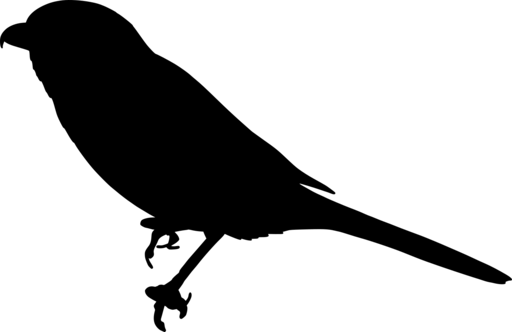
Great Grey Shrike
Lanius excubitor
Silhouette: Andy Wilson · PhyloPic
- KingdomAnimalia (Animals)
- PhylumChordata (Chordates)
- ClassAves (Birds)
- OrderPasseriformes (Perching Birds)
- FamilyLaniidae (Shrikes)
- GenusLanius (Typical Shrikes)
- SpeciesLanius excubitor (Great Grey Shrike)
About the Great Grey Shrike
The great grey shrike (Lanius excubitor) is a large and predatory songbird species in the shrike family (Laniidae). It forms a superspecies with its parapatric southern relatives, the Iberian grey shrike (L. meridionalis), the Chinese grey shrike (L. sphenocerus) and the American loggerhead shrike (L. ludovicianus). Males and females are similar in plumage, pearly grey above with a black eye-mask and white underparts.
Breeding takes place generally north of 50° northern latitude in northern Europe and Asia. Most populations migrate south in winter to temperate regions. The great grey shrike is carnivorous, with rodents making up over half its diet.
The species was first scientifically described by the Swedish physician Carl Linnaeus in his 1758 edition of Systema Naturae under the current binomial name. His description is L[anius] cauda cuneiformi lateribus alba, dorso cano, alis nigris macula alba – "a shrike with a wedge-shaped white-bordered tail, back grey, wings black with white spot". At that time, none of the other grey shrikes – including the lesser grey shrike (L. minor), for which the description of the tail pattern is incorrect and which some... Wikipedia →
Recent sightings of Great Grey Shrike in Jim Corbett National Park
LIVEiNaturalistClosest Relatives at Jim Corbett National Park

 Long-tailed Shrike
Lanius schach

Bay-backed Shrike
Lanius vittatus

Grey-backed Shrike
Lanius tephronotus

Brown Shrike
Lanius cristatus

 White-cheeked Bulbul
Pycnonotus leucogenys

 Jungle Babbler
Turdoides striata

Red-whiskered Bulbul
Pycnonotus jocosus

 Blue Whistling-Thrush
Myophonus caeruleus

 Indian White-eye
Zosterops palpebrosus

White-crested Laughingthrush
Garrulax leucolophus

 Grey Bushchat
Saxicola ferreus

Pied Bushchat
Saxicola caprata
Global Distribution
Warmer areas are where this animal is recorded most often.
Parks Where Found
| # | Park | Country | Daily sighting probability |
|---|---|---|---|
| 1 | Biebrza National Park | 🇵🇱 Poland | |
| 2 | Białowieża National Park | 🇵🇱 Poland | |
| 3 | Hortobágy National Park | 🇭🇺 Hungary | |
| 4 | Kiskunság National Park | 🇭🇺 Hungary | |
| 5 | Gobi Gurvansaikhan National Park | 🇲🇳 Mongolia | |
| 6 | Fertő-Hanság National Park | 🇭🇺 Hungary | |
| 7 | Ranthambore National Park | 🇮🇳 India | |
| 8 | Awash National Park | 🇪🇹 Ethiopia | |
| 9 | Bavarian Forest National Park | 🇩🇪 Germany | |
| 10 | Gauja National Park | 🇱🇻 Latvia | |
| 11 | Cairngorms National Park | 🇬🇧 United Kingdom | |
| 12 | Wadden Sea National Park | 🇩🇪 Germany | |
| 13 | Keoladeo National Park | 🇮🇳 India | |
| 14 | Ecrins National Park | 🇫🇷 France | |
| 15 | Triglav National Park | 🇸🇮 Slovenia | |
| 16 | Cévennes National Park | 🇫🇷 France | |
| 17 | Tatra National Park | 🇸🇰 Slovakia | |
| 18 | Jim Corbett National Park | 🇮🇳 India | |
| 19 | Snowdonia National Park | 🇬🇧 United Kingdom | |
| 20 | Pyrénées National Park | 🇫🇷 France |