


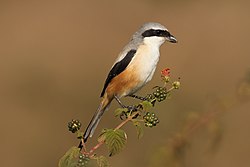


Long-tailed Shrike
Lanius schach
Silhouette: Andy Wilson · PhyloPic
- KingdomAnimalia (Animals)
- PhylumChordata (Chordates)
- ClassAves (Birds)
- OrderPasseriformes (Perching Birds)
- FamilyLaniidae (Shrikes)
- GenusLanius (Typical Shrikes)
- SpeciesLanius schach (Long-tailed Shrike)
About the Long-tailed Shrike
The long-tailed shrike or rufous-backed shrike (Lanius schach) is a member of the bird family Laniidae, the shrikes. They are found widely distributed across Asia and there are variations in plumage across the range. The species ranges across much of Asia, both on the mainland and the eastern archipelagos. The eastern or Himalayan subspecies, L. s. tricolor, is sometimes called the black-headed shrike. Although there are considerable differences in plumage among the subspecies, they all have a long and narrow black tail, have a black mask and forehead, rufous rump and flanks and a small white patch on the shoulder. It is considered to form a superspecies with the grey-backed shrike (Lanius tephronotus) which breeds on the Tibetan Plateau.
The long-tailed shrike was formally described by the Swedish naturalist Carl Linnaeus in 1758 in the tenth edition of his Systema Naturae under the binomial name Lanius schach. Linnaeus cited the description that the Swedish explorer Pehr Osbeck had included in the account of his stay in China. The type locality is the Canton area of China. The genus name, Lanius, is derived from the Latin word for "butcher", and some shrikes are also... Wikipedia →
Recent sightings of Long-tailed Shrike in Jim Corbett National Park
LIVEiNaturalistClosest Relatives at Jim Corbett National Park

 Bay-backed Shrike
Lanius vittatus

Grey-backed Shrike
Lanius tephronotus

Brown Shrike
Lanius cristatus

Great Grey Shrike
Lanius excubitor

 White-cheeked Bulbul
Pycnonotus leucogenys

 Jungle Babbler
Turdoides striata

Red-whiskered Bulbul
Pycnonotus jocosus

 Blue Whistling-Thrush
Myophonus caeruleus

 Indian White-eye
Zosterops palpebrosus

White-crested Laughingthrush
Garrulax leucolophus

 Grey Bushchat
Saxicola ferreus

Pied Bushchat
Saxicola caprata
Global Distribution
Warmer areas are where this animal is recorded most often.
Parks Where Found
Quick answers
What are the chances of seeing a Long-tailed Shrike in Jim Corbett National Park?
About 50% of wildlife watchers report a Long-tailed Shrike sighting in Jim Corbett National Park, based on 1,241 verified sightings from GBIF citizen-science data.
When is the best time to see Long-tailed Shrike in Jim Corbett National Park?
November has the highest sighting rate for Long-tailed Shrike in Jim Corbett National Park in our monthly data.