
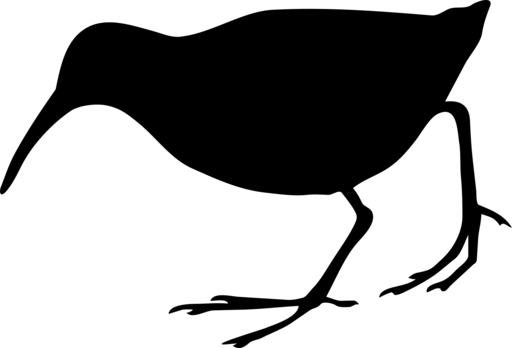
African Rail
Rallus caerulescens
Silhouette: Ferran Sayol · PhyloPic
- KingdomAnimalia (Animals)
- PhylumChordata (Chordates)
- ClassAves (Birds)
- OrderGruiformes (Cranes, Rails, and Allies)
- FamilyRallidae (Rails, Gallinules, and Coots)
- GenusRallus (Typical Rails)
- SpeciesRallus caerulescens (African Rail)
About the African Rail
The African rail (Rallus caerulescens), sometimes also Kaffir rail, is a small wetland bird of the rail family that is found in eastern and southern Africa. The African rail was formally described in 1789 by the German naturalist Johann Friedrich Gmelin in his revised and expanded edition of Carl Linnaeus's Systema Naturae. He placed it with all the other rails in the genus Rallus and coined the binomial name Rallus caerulescens. Gmelin based his description on the "blue necked rail" from the Cape of Good Hope that had been described in 1785 by the English ornithologist John Latham in his book A General Synopsis of Birds. The naturalist Joseph Banks had provided Latham with a water-colour drawing of the rail by Georg Forster who had accompanied James Cook on his second voyage to the Pacific Ocean. The picture was painted in 1773 at the Cape of Good Hope. It is now the holotype for the species and is held by the Natural History Museum in London. The specific epithet caerulescens is from Latin and means "bluish". The species is monotypic: no subspecies are recognised.
Adults are 27–28 cm (10.6–11.0 in) long, and have mainly brown upperparts and blue-grey... Wikipedia →
Recent sightings of African Rail in Kruger National Park
LIVEiNaturalistClosest Relatives at Kruger National Park

 Black Crake
Amaurornis flavirostra

 Common Moorhen
Gallinula chloropus

Baillon's Crake
Porzana pusilla
 Streaky-breasted Flufftail
Sarothrura boehmi

 African Crake
Crex egregia

Lesser Moorhen
Gallinula angulata

 Red-knobbed Coot
Fulica cristata

 Allen's Gallinule
Porphyrio alleni

Western Swamphen
Porphyrio porphyrio

Buff-spotted Flufftail
Sarothrura elegans

Corn Crake
Crex crex

Red-chested Flufftail
Sarothrura rufa
Global Distribution
Warmer areas are where this animal is recorded most often.