


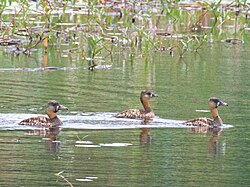

White-backed Duck
Thalassornis leuconotus
Silhouette: Sheatherius · PhyloPic
- KingdomAnimalia (Animals)
- PhylumChordata (Chordates)
- ClassAves (Birds)
- OrderAnseriformes (Waterfowl)
- FamilyAnatidae (Ducks, Geese, and Swans)
- GenusThalassornis
- SpeciesThalassornis leuconotus (White-backed Duck)
About the White-backed Duck
The white-backed duck (Thalassornis leuconotus) is a waterbird of the family Anatidae. It is distinct from all other ducks, but most closely related to the whistling ducks in the subfamily Dendrocygninae, though also showing some similarities to the stiff-tailed ducks in the subfamily Oxyurinae. It is the only member of the genus Thalassornis.
These birds are well adapted for diving. On occasions they have been observed to stay under water for up to half a minute. They search especially for the bulbs of waterlilies, but also seeds and leaves of waterlilies and other water plants and the young feed on lake flies larvae as well. From danger, they also escape preferentially by diving; hence, the namesake white back is hardly visible in life.
White-backed ducks live in Africa, especially between Senegal and Chad in the west, Ethiopia in the east, and South Africa in the south. Their habitat consists of lakes, ponds, swamps and marshes where they are well camouflaged against predators.
There are two subspecies, Thalassornis leuconotus leuconotus and Thalassornis leuconotus insularis. The latter lives entirely on Madagascar... Wikipedia →
Recent sightings of White-backed Duck in Lake Nakuru National Park
LIVEiNaturalistClosest Relatives at Lake Nakuru National Park

 Egyptian Goose
Alopochen aegyptiaca

 Yellow-billed Duck
Anas undulata

Cape Teal
Anas capensis

Red-billed Teal
Anas erythrorhyncha

Hottentot Teal
Spatula hottentota

 White-faced Whistling Duck
Dendrocygna viduata

 Northern Shoveler
Spatula clypeata

African Black Duck
Anas sparsa

Comb Duck
Sarkidiornis melanotos

Fulvous Whistling-Duck
Dendrocygna bicolor

Spur-winged Goose
Plectropterus gambensis

Garganey
Spatula querquedula
Global Distribution
Warmer areas are where this animal is recorded most often.