


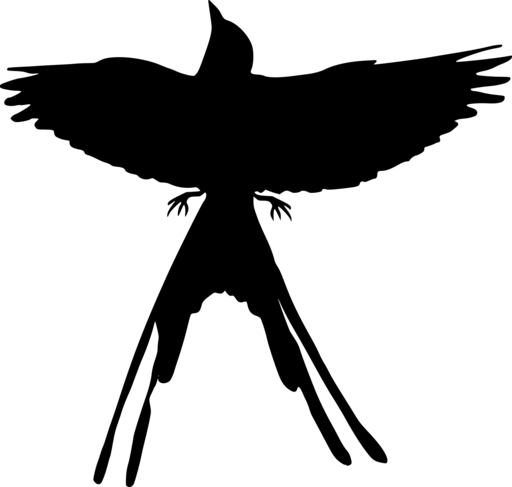
Scissor-tailed Flycatcher
Tyrannus forficatus
Silhouette: PhyloPic · PhyloPic
- KingdomAnimalia (Animals)
- PhylumChordata (Chordates)
- ClassAves (Birds)
- OrderPasseriformes (Perching Birds)
- FamilyTyrannidae (Tyrant Flycatchers)
- GenusTyrannus (Kingbirds)
- SpeciesTyrannus forficatus (Scissor-tailed Flycatcher)
About the Scissor-tailed Flycatcher
The scissor-tailed flycatcher (Tyrannus forficatus), known as swallow-tailed flycatcher or scissorstail, is a long-tailed insectivorous bird of the genus Tyrannus, whose members are collectively referred to as kingbirds. It is found in North and Central America, and is Oklahoma's State Bird.
The scissor-tailed flycatcher was formally described in 1789 by the German naturalist Johann Friedrich Gmelin in his revised and expanded edition of Carl Linnaeus's Systema Naturae. He placed it with the flycatchers in the genus Muscicapa and coined the binomial name Muscicapa forficata. The specific epithet is from Latin forfex, forficis meaning "a pair of scissors". Gmelin based his description on "Le moucherolle à queue fourchue du Mexique" (French: "the Mexican swallow-tailed flycatcher") that had been described in 1778 by the French polymath Comte de Buffon from a specimen from Mexico and illustrated with a hand-coloured engraving by François-Nicolas Martinet.
The scissor-tailed flycatcher is now one of 13 species placed in the kingbird genus Tyrannus that was introduced in 1799 by Bernard Germain de Lacépède. The species is monotypic: no subspecies are recognised. Within the... Wikipedia →
Recent sightings of Scissor-tailed Flycatcher in Masaya Volcano National Park
LIVEiNaturalistClosest Relatives at Masaya Volcano National Park

 Tropical Kingbird
Tyrannus melancholicus

Eastern Kingbird
Tyrannus tyrannus

Western Kingbird
Tyrannus verticalis

 Great Kiskadee
Pitangus sulphuratus

 Social Flycatcher
Myiozetetes similis

Boat-billed Flycatcher
Megarynchus pitangua

 Dusky-capped Flycatcher
Myiarchus tuberculifer

Sulphur-bellied Flycatcher
Myiodynastes luteiventris

 Olive-sided Flycatcher
Contopus cooperi

 Great Crested Flycatcher
Myiarchus crinitus

Brown-crested Flycatcher
Myiarchus tyrannulus

Eastern Wood-Pewee
Contopus virens
Global Distribution
Warmer areas are where this animal is recorded most often.
Parks Where Found
Quick answers
What are the chances of seeing a Scissor-tailed Flycatcher in Masaya Volcano National Park?
Under 5% of wildlife watchers report a Scissor-tailed Flycatcher sighting in Masaya Volcano National Park, based on 70 verified sightings from GBIF citizen-science data.
When is the best time to see Scissor-tailed Flycatcher in Masaya Volcano National Park?
January has the highest sighting rate for Scissor-tailed Flycatcher in Masaya Volcano National Park in our monthly data.