
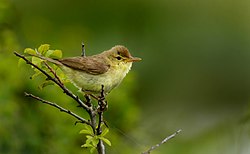



Melodious Warbler
Hippolais polyglotta
Silhouette: John Gerrard Keulemans · PhyloPic
- KingdomAnimalia (Animals)
- PhylumChordata (Chordates)
- ClassAves (Birds)
- OrderPasseriformes (Perching Birds)
- FamilyAcrocephalidae (Reed Warblers and Allies)
- GenusHippolais
- SpeciesHippolais polyglotta (Melodious Warbler)
About the Melodious Warbler
The melodious warbler (Hippolais polyglotta) is an Old World warbler in the tree warbler genus Hippolais. It breeds in southwest Europe and northwest Africa. It is migratory, wintering in sub-Saharan Africa. This small passerine bird is a species found in open woodland with bushes. Three to five eggs are laid in a nest in a tree or a bush. This is a common bird in many parts of its wide range and the International Union for Conservation of Nature has rated its conservation status as being of "least concern".
The genus name Hippolais is from Ancient Greek hupolais, as misspelt by Linnaeus. It referred to a small bird mentioned by Aristotle and others and may be onomatopoeic or derived from hupo,"under", and laas, "stone". The specific polyglotta is from Ancient Greek polus, "many", and glossa, "tongue" and means "harmonious".
This is a medium-sized warbler, 12 to 13 cm (4.7 to 5.1 in) in length, and similar to its eastern counterpart, the icterine warbler (Hippolais icterina). The adult has a plain brown back and wings, and yellowish underparts. Compared to the icterine warbler, the upper parts are rather browner and the under parts rather yellower... Wikipedia →
Recent sightings of Melodious Warbler in Mercantour National Park
LIVEiNaturalistClosest Relatives at Mercantour National Park

 Eurasian Reed-Warbler
Acrocephalus scirpaceus

 Chaffinch
Fringilla coelebs

 Black Redstart
Phoenicurus ochruros

 Carrion Crow
Corvus corone

 Great Tit
Parus major

 Eurasian Blackbird
Turdus merula

 European Robin
Erithacus rubecula

 Eurasian Jay
Garrulus glandarius

 Common Chiffchaff
Phylloscopus collybita

 Eurasian Goldfinch
Carduelis carduelis

 Coal Tit
Periparus ater

 Blackcap
Sylvia atricapilla
Global Distribution
Warmer areas are where this animal is recorded most often.
Parks Where Found
| # | Park | Country | Daily sighting probability |
|---|---|---|---|
| 1 | Niokolo-Koba National Park | 🇸🇳 Senegal | |
| 2 | Cévennes National Park | 🇫🇷 France | |
| 3 | Camargue | 🇫🇷 France | |
| 4 | Doñana National Park | 🇪🇸 Spain | |
| 5 | Sierra de Guadarrama National Park | 🇪🇸 Spain | |
| 6 | Pyrénées National Park | 🇫🇷 France | |
| 7 | Monfragüe National Park | 🇪🇸 Spain | |
| 8 | Sierra Nevada National Park | 🇪🇸 Spain | |
| 9 | Ordesa y Monte Perdido National Park | 🇪🇸 Spain | |
| 10 | Aigüestortes National Park | 🇪🇸 Spain | |
| 11 | Picos de Europa National Park | 🇪🇸 Spain | |
| 12 | Mercantour National Park | 🇫🇷 France | |
| 13 | Wadden Sea National Park | 🇩🇪 Germany |