



Woodchat Shrike
Lanius senator
Silhouette: Andy Wilson · PhyloPic
- KingdomAnimalia (Animals)
- PhylumChordata (Chordates)
- ClassAves (Birds)
- OrderPasseriformes (Perching Birds)
- FamilyLaniidae (Shrikes)
- GenusLanius (Typical Shrikes)
- SpeciesLanius senator (Woodchat Shrike)
About the Woodchat Shrike
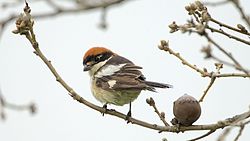
The woodchat shrike (Lanius senator) is a member of the shrike family Laniidae. It can be identified by its red-brown crown and nape. It is mainly insectivorous and favours open wooded areas with scattered trees such as orchards, particularly when there is bare or sandy ground. The woodchat shrike breeds in southern Europe, the Middle East and northwest Africa, and winters in tropical Africa.
The woodchat shrike was formally described by the Swedish naturalist Carl Linnaeus in 1758 in the tenth edition of his Systema Naturae under the binomial name Lanius senator. Linnaeus based his description on the "red headed butcher-bird" that had been described and illustrated in 1734 by the English naturalist Eleazar Albin in the second volume of his A Natural History of Birds. Linnaeus mistakenly specified the type locality as "Indiis". This was corrected to the River Rhine in Germany by Ernst Hartert in 1907. The genus name, Lanius, is derived from the Latin word for "butcher", and some shrikes are also known as "butcher birds" because of their feeding habits. The specific senator is Latin for "senator", so-named because its chestnut cap recalled the colour of the stripe on the... Wikipedia →
Recent sightings of Woodchat Shrike in Mercantour National Park
LIVEiNaturalistClosest Relatives at Mercantour National Park

 Red-backed Shrike
Lanius collurio

 Chaffinch
Fringilla coelebs

 Black Redstart
Phoenicurus ochruros

 Carrion Crow
Corvus corone

 Great Tit
Parus major

 Eurasian Blackbird
Turdus merula

 European Robin
Erithacus rubecula

 Eurasian Jay
Garrulus glandarius

 Common Chiffchaff
Phylloscopus collybita

 Eurasian Goldfinch
Carduelis carduelis

 Coal Tit
Periparus ater

 Blackcap
Sylvia atricapilla
Global Distribution
Warmer areas are where this animal is recorded most often.
Parks Where Found
| # | Park | Country | Daily sighting probability |
|---|---|---|---|
| 1 | Monfragüe National Park | 🇪🇸 Spain | |
| 2 | Awash National Park | 🇪🇹 Ethiopia | |
| 3 | Doñana National Park | 🇪🇸 Spain | |
| 4 | Sierra de Guadarrama National Park | 🇪🇸 Spain | |
| 5 | Kidepo Valley National Park | 🇺🇬 Uganda | |
| 6 | Sierra Nevada National Park | 🇪🇸 Spain | |
| 7 | Murchison Falls National Park | 🇺🇬 Uganda | |
| 8 | Niokolo-Koba National Park | 🇸🇳 Senegal | |
| 9 | Pyrénées National Park | 🇫🇷 France | |
| 10 | Cévennes National Park | 🇫🇷 France | |
| 11 | Camargue | 🇫🇷 France | |
| 12 | Plitvice Lakes National Park | 🇭🇷 Croatia | |
| 13 | Mercantour National Park | 🇫🇷 France | |
| 14 | Fertő-Hanság National Park | 🇭🇺 Hungary | |
| 15 | Kiskunság National Park | 🇭🇺 Hungary | |
| 16 | Wadden Sea National Park | 🇩🇪 Germany |