


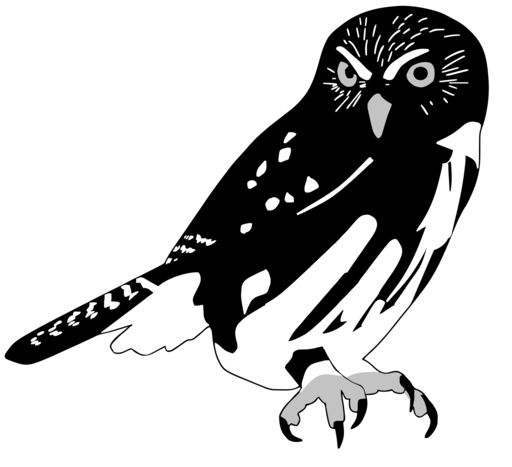
Asian Barred Owlet
Glaucidium cuculoides
Silhouette: Edwin Price · PhyloPic
- KingdomAnimalia (Animals)
- PhylumChordata (Chordates)
- ClassAves (Birds)
- OrderStrigiformes (Owls)
- FamilyStrigidae (Typical Owls)
- GenusGlaucidium (Pygmy-Owls and Typical Owlets)
- SpeciesGlaucidium cuculoides (Asian Barred Owlet)
About the Asian Barred Owlet
The Asian barred owlet (Glaucidium cuculoides), also known as the cuckoo owlet, is a species of pygmy owl native to the forests and shrublands of mainland Southeast Asia to the foothills of the Himalayas of northern Pakistan. It is a smaller owl, measuring 22–25 cm (8.7–9.8 in), making it one of the larger pygmy owls. They are primarily insectivorous but will eat lizards, small rodents and birds as well.
The Asian barred owlet is a small owl that sits at 22–25 cm (8.7–9.8 in). The males weigh 150–176 g (0.331–0.388 lb) and the females up to 240 g (0.53 lb). Like most owls in the true owl family, the females are usually larger than the males. They are dark brown or olive-brown with a white throat patch and are densely barred. Their breast and belly is whitish in colour with dark brown bars. Its tail and wings are dark brown with whitish bars. Unlike other pygmy owl species, they do not have false eyes on the back of their head. The juveniles have a streaked breast, not barred, and their head is a more ruddy brown colour. They are similar in appearance to the Javan owlet and collared owlet. The Asian barred owlet is mainly diurnal and will perch on bare branches to hunt... Wikipedia →
Recent sightings of Asian Barred Owlet in Namdapha National Park
LIVEiNaturalistClosest Relatives at Namdapha National Park

 Collared Owlet
Glaucidium brodiei

 Brown Boobook
Ninox scutulata

 Mountain Scops-Owl
Otus spilocephalus

Collared Scops Owl
Otus lettia

 Spot-bellied Eagle-Owl
Ketupa nipalensis

Oriental Scops Owl
Otus sunia

 Brown Wood Owl
Strix leptogrammica

Tawny Fish-Owl
Ketupa flavipes

Spotted Owlet
Athene brama

 Oriental Bay-Owl
Phodilus badius
Global Distribution
Warmer areas are where this animal is recorded most often.
Parks Where Found
| # | Park | Country | Daily sighting probability |
|---|---|---|---|
| 1 | Kaziranga National Park | 🇮🇳 India | |
| 2 | Cuc Phuong National Park | 🇻🇳 Vietnam | |
| 3 | Royal Manas National Park | 🇧🇹 Bhutan | |
| 4 | Cat Tien National Park | 🇻🇳 Vietnam | |
| 5 | Kaeng Krachan National Park | 🇹🇭 Thailand | |
| 6 | Doi Inthanon National Park | 🇹🇭 Thailand | |
| 7 | Namdapha National Park | 🇮🇳 India | |
| 8 | Manas National Park | 🇮🇳 India | |
| 9 | Khangchendzonga National Park | 🇮🇳 India | |
| 10 | Khao Yai National Park | 🇹🇭 Thailand | |
| 11 | Jim Corbett National Park | 🇮🇳 India | |
| 12 | Chitwan National Park | 🇳🇵 Nepal | |
| 13 | Langtang National Park | 🇳🇵 Nepal | |
| 14 | Royal Bardia National Park | 🇳🇵 Nepal |
Quick answers
What are the chances of seeing a Asian Barred Owlet in Namdapha National Park?
About 20% of wildlife watchers report a Asian Barred Owlet sighting in Namdapha National Park, based on 335 verified sightings from GBIF citizen-science data.
When is the best time to see Asian Barred Owlet in Namdapha National Park?
January has the highest sighting rate for Asian Barred Owlet in Namdapha National Park in our monthly data.