



African Grass Rat
Arvicanthis niloticus
Silhouette: T. Michael Keesey · PhyloPic
- KingdomAnimalia (Animals)
- PhylumChordata (Chordates)
- ClassMammalia (Mammals)
- OrderRodentia (Rodents)
- FamilyMuridae (Old World Mice and Rats)
- GenusArvicanthis (Grass Rats)
- SpeciesArvicanthis niloticus (African Grass Rat)
About the African Grass Rat
The African grass rat (Arvicanthis niloticus) is a species of rodent in the family Murinae. The species is divided into the following six subspecies. A. n. niloticus: Nile, Egypt; A. n. dembeensis (Rüppell, 1842): Sudan, Ethiopia, Eritrea; Tanzania, Kenya, Burundi, Uganda, Democratic Republic of Congo;
A. n. naso (Pocock, 1934): Yemen; A. n. rhodesiae (St.Leger, 1932): Zambia; A. n. solatus (Thomas, 1925): Senegal; Mauritania, Mali, Niger, Chad, Burkina Faso, Ghana, Nigeria, Cameroon and Central African Republic; A. n. testicularis (Sundevall, 1843): upper Nile, central Sudan.
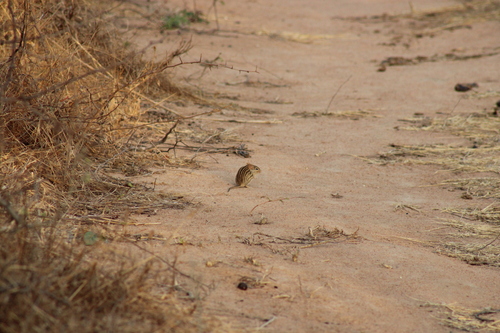
Arvicanthis niloticus is a rodent of medium size, with the length of the head and of the body between 159 and 202 mm, the length of the tail between 125 and 173 mm, the length of the foot between 33 and 42 mm, the length of the ears between 19 and 23 mm and a weight up to 201 g.
The fur is rough. The upper parts of individual hairs are yellowish with blackish tips. Long yellow or orange hairs are present on the bottom. A dorsal dark stripe more or less distinct extends from the head to the base of the tail. The ventral parts are whitish, with the base of the hairs blackish... Wikipedia →
Recent sightings of African Grass Rat in Ngorongoro Conservation Area
LIVEiNaturalistClosest Relatives at Ngorongoro Conservation Area

 Single-striped Grass Mouse
Lemniscomys rosalia

Typical Lemniscomys
Lemniscomys striatus
Heuglin's Lemniscomys
Lemniscomys zebra

Mesic Four-striped Grass Rat
Rhabdomys dilectus

 Ochre Bush Squirrel
Paraxerus ochraceus

 East African Spring-hare
Pedetes surdaster

 Crested Porcupine
Hystrix cristata

Unstriped Ground Squirrel
Xerus rutilus
Global Distribution
Warmer areas are where this animal is recorded most often.
Parks Where Found
| # | Park | Country | Daily sighting probability |
|---|---|---|---|
| 1 | Serengeti National Park | 🇹🇿 Tanzania | |
| 2 | Ngorongoro Conservation Area | 🇹🇿 Tanzania | |
| 3 | Lake Nakuru National Park | 🇰🇪 Kenya | |
| 4 | Masai Mara National Reserve | 🇰🇪 Kenya | |
| 5 | Queen Elizabeth National Park | 🇺🇬 Uganda | |
| 6 | Murchison Falls National Park | 🇺🇬 Uganda | |
| 7 | Virunga National Park | 🇨🇩 Democratic Republic of the Congo |
Quick answers
What are the chances of seeing a African Grass Rat in Ngorongoro Conservation Area?
About 20% of wildlife watchers report a African Grass Rat sighting in Ngorongoro Conservation Area, based on 52 verified sightings from GBIF citizen-science data.
When is the best time to see African Grass Rat in Ngorongoro Conservation Area?
April has the highest sighting rate for African Grass Rat in Ngorongoro Conservation Area in our monthly data.