


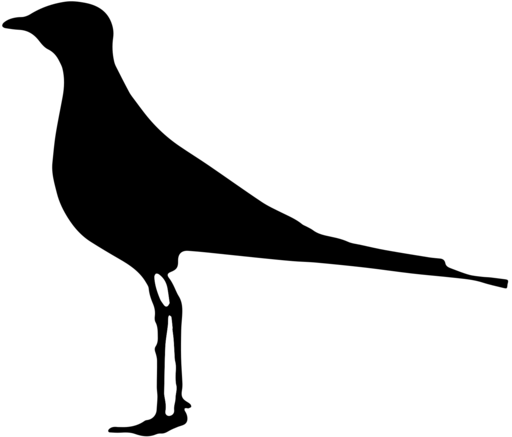
Double-banded Courser
Rhinoptilus africanus
Silhouette: Cristian Gutierrez-Ibanez · PhyloPic
- KingdomAnimalia (Animals)
- PhylumChordata (Chordates)
- ClassAves (Birds)
- OrderCharadriiformes (Shorebirds and Allies)
- FamilyGlareolidae (Pratincoles and Coursers)
- GenusRhinoptilus (Short-billed Coursers)
- SpeciesRhinoptilus africanus (Double-banded Courser)
About the Double-banded Courser
The double-banded courser (Smutsornis africanus), also known as the two-banded courser, is a species of bird in the family Glareolidae. It was formerly placed in the genus Rhinoptilus but is now the only species placed in the genus Smutsornis.
The double-banded courser was formally described in 1807 as Cursorius africanus by the Dutch zoologist Coenraad Jacob Temminck. The specimen had been collected by François Levaillant in Namaqualand on the west coast of southern Africa. This species was formerly placed in the genus Rhinoptilus. A 2022 molecular genetic study by David Cerný and Rossy Natale found that the double-banded courser diverged genetically from the other species in Rhinoptilus. The species was therefore moved to the resurrected genus Smutsornis that had been introduced in 1922 by South African zoologist Austin Roberts. The genus name combines the name of the South African politician Jan Smuts with the Ancient Greek ορνις/ornis, ορνιθος/ornithos meaning "bird".
Eight subspecies are recognised: S. a. raffertyi (Mearns, EA, 1915) – Eritrea to Ethiopia and Djibouti S. a. hartingi (Sharpe, RB, 1893) – southeastern Ethiopia (Ogaden Depression) and Somalia S. a... Wikipedia →
Recent sightings of Double-banded Courser in Ngorongoro Conservation Area
LIVEiNaturalistClosest Relatives at Ngorongoro Conservation Area

 Three-banded Courser
Rhinoptilus cinctus

Bronze-winged Courser
Rhinoptilus chalcopterus

 Collared Pratincole
Glareola pratincola

Temminck's Courser
Cursorius temminckii

 Blacksmith Lapwing
Vanellus armatus

Crowned Lapwing
Vanellus coronatus

 Black-winged Stilt
Himantopus himantopus

Gull-billed Tern
Gelochelidon nilotica

 Little Stint
Calidris minuta

 Ruff
Calidris pugnax

 Pied Avocet
Recurvirostra avosetta

 Wood Sandpiper
Tringa glareola
Global Distribution
Warmer areas are where this animal is recorded most often.
Parks Where Found
| # | Park | Country | Daily sighting probability |
|---|---|---|---|
| 1 | Amboseli National Park | 🇰🇪 Kenya | |
| 2 | Etosha National Park | 🇳🇦 Namibia | |
| 3 | Tarangire National Park | 🇹🇿 Tanzania | |
| 4 | Serengeti National Park | 🇹🇿 Tanzania | |
| 5 | Ngorongoro Conservation Area | 🇹🇿 Tanzania | |
| 6 | Lake Manyara National Park | 🇹🇿 Tanzania | |
| 7 | Tsavo West National Park | 🇰🇪 Kenya | |
| 8 | Masai Mara National Reserve | 🇰🇪 Kenya | |
| 9 | Chobe National Park | 🇧🇼 Botswana | |
| 10 | Namib-Naukluft National Park | 🇳🇦 Namibia | |
| 11 | Tsavo East National Park | 🇰🇪 Kenya | |
| 12 | Kgalagadi Transfrontier Park | 🇿🇦 South Africa | |
| 13 | Ruaha National Park | 🇹🇿 Tanzania | |
| 14 | Addo Elephant National Park | 🇿🇦 South Africa | |
| 15 | Mkomazi National Park | 🇹🇿 Tanzania | |
| 16 | Moremi Game Reserve | 🇧🇼 Botswana | |
| 17 | Lake Nakuru National Park | 🇰🇪 Kenya |
Quick answers
What are the chances of seeing a Double-banded Courser in Ngorongoro Conservation Area?
About 10% of wildlife watchers report a Double-banded Courser sighting in Ngorongoro Conservation Area, based on 374 verified sightings from GBIF citizen-science data.
When is the best time to see Double-banded Courser in Ngorongoro Conservation Area?
April has the highest sighting rate for Double-banded Courser in Ngorongoro Conservation Area in our monthly data.