


Forrer's Grass Frog
Lithobates forreri
Silhouette: Jose Carlos Arenas-Monroy · PhyloPic
- KingdomAnimalia (Animals)
- PhylumChordata (Chordates)
- ClassAmphibia (Amphibians)
- OrderAnura (Frogs and Toads)
- FamilyRanidae (Typical Frogs)
- GenusLithobates (American Water Frogs)
- SpeciesLithobates forreri (Forrer's Grass Frog)
About the Forrer's Grass Frog
Forrer's grass frog or Forrer's leopard frog (Lithobates forreri) is a species of frog in the family Ranidae found in Mexico and Central America through Guatemala, El Salvador, Honduras, and Nicaragua to Costa Rica. It is a widespread and common frog found in lowland and seasonal tropical forests. It can also adapt to man-made habitats such as flooded agricultural lands and other water content systems. Reproduction requires permanent pools and lagoons.
Hillis D.M., Frost J.S., Wright D.A. (1983). "Phylogeny and biogeography of the Rana pipiens complex: A biochemical evaluation". Systematic Zoology. 32 (2): 132–143. doi:10.2307/2413277. JSTOR 2413277.{{cite journal}}: CS1 maint: multiple names: authors list (link)
Hillis D.M. (1988). "Systematics of the Rana pipiens complex: Puzzle and paradigm". Annual Review of Ecology and Systematics. 19: 39–63. doi:10.1146/annurev.es.19.110188.000351. Hillis D.M., Wilcox T.P. (2005). "Phylogeny of the New World true frogs (Rana)" (PDF). Molecular Phylogenetics and Evolution. 34 (2): 299–314. doi:10.1016/j.ympev.2004.10.007. PMID 15619443. Archived from the original (PDF) on 2008-05-28.
Hillis D. M. (2007). "Constraints in naming... Wikipedia →
Recent sightings of Forrer's Grass Frog in Palo Verde National Park
LIVEiNaturalistClosest Relatives at Palo Verde National Park

 Vaillant's Frog
Lithobates vaillanti

 Stauffer's Tree Frog
Scinax staufferi

Mexican Smilisca
Smilisca baudinii

 Giant Marine Toad
Rhinella horribilis

Yellow Treefrog
Dendropsophus microcephalus
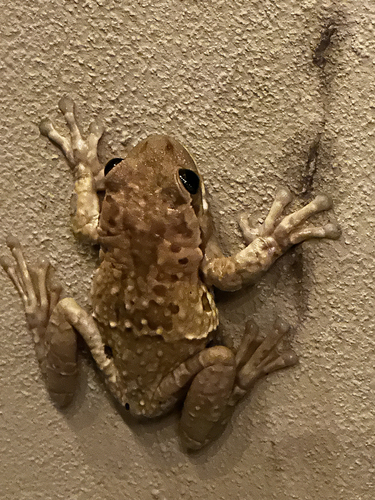
 Milk Frog
Trachycephalus macrotis

 Sheep Frog
Hypopachus variolosus

 Yellow Toad
Incilius luetkenii

 Guayaquil Dwarf Frog
Engystomops pustulosus

 Mexican Burrowing Toad
Rhinophrynus dorsalis

 Mexican White-lipped Frog
Leptodactylus fragilis

Black Jungle-Frog
Leptodactylus melanonotus
Global Distribution
Warmer areas are where this animal is recorded most often.
Parks Where Found
| # | Park | Country | Daily sighting probability |
|---|---|---|---|
| 1 | Santa Rosa National Park | 🇨🇷 Costa Rica | |
| 2 | Palo Verde National Park | 🇨🇷 Costa Rica | |
| 3 | Monteverde Cloud Forest Reserve | 🇨🇷 Costa Rica | |
| 4 | Tenorio Volcano National Park | 🇨🇷 Costa Rica | |
| 5 | Arenal Volcano National Park | 🇨🇷 Costa Rica | |
| 6 | Celaque National Park | 🇭🇳 Honduras | |
| 7 | Las Baulas Marine National Park | 🇨🇷 Costa Rica | |
| 8 | Carara National Park | 🇨🇷 Costa Rica |
Quick answers
What are the chances of seeing a Forrer's Grass Frog in Palo Verde National Park?
About 20% of wildlife watchers report a Forrer's Grass Frog sighting in Palo Verde National Park, based on 10 verified sightings from GBIF citizen-science data.
When is the best time to see Forrer's Grass Frog in Palo Verde National Park?
August has the highest sighting rate for Forrer's Grass Frog in Palo Verde National Park in our monthly data.