

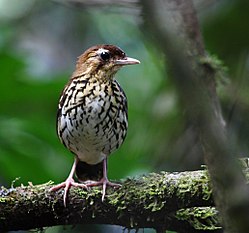



Short-tailed Antthrush
Chamaeza campanisona
Silhouette: Abraão B. Leite · PhyloPic
- KingdomAnimalia (Animals)
- PhylumChordata (Chordates)
- ClassAves (Birds)
- OrderPasseriformes (Perching Birds)
- FamilyFormicariidae (Antthrushes)
- GenusChamaeza (Chamaeza Antthrushes)
- SpeciesChamaeza campanisona (Short-tailed Antthrush)
About the Short-tailed Antthrush
The short-tailed antthrush (Chamaeza campanisona) is a species of bird in the family Formicariidae. It is found in every mainland South American country except Chile, French Guiana, and Uruguay. The short-tailed antthrush was first formally described by Vieillot in 1818 as Turdus brevicaudus. However, because that binomial had previously applied to another species, by the principle of priority Lichtenstein's 1823 description as Myiothera campanisona is recognized as the original. The species was later moved to its current genus Chamaeza. Its specific epithet comes from the Latin "campana" (bell) and "sonus" (sound) and refers to the species' bell-like song.
The International Ornithological Congress (IOC) assigns the short-tailed antthrush these 11 subspecies: A 2003 publication assigns a twelfth subspecies, C. c. tshororo, though the authors note that it is "doubtfully distinct from [the] nominate" C. c. campanisona. The authors also suggest that the short-tailed antthrush as currently known may include as many as four species. The Clements taxonomy and BirdLife International's Handbook of the Birds of the World recognize C. c. tshororo; the IOC includes... Wikipedia →
Recent sightings of Short-tailed Antthrush in Podocarpus National Park
LIVEiNaturalistClosest Relatives at Podocarpus National Park

 Barred Antthrush
Chamaeza mollissima

Rufous-breasted Antthrush
Formicarius rufipectus

 Blue-and-white Swallow
Notiochelidon cyanoleuca

 Masked Flowerpiercer
Diglossa cyanea

Lacrimose Mountain-Tanager
Anisognathus lacrymosus

Blue-necked Tanager
Stilpnia cyanicollis

 Yellow-breasted Brush-Finch
Atlapetes latinuchus

 Great Thrush
Turdus fuscater

Green Jay
Cyanocorax yncas

Russet-backed Oropendola
Psarocolius angustifrons

 Tropical Kingbird
Tyrannus melancholicus

 Spectacled Redstart
Myioborus melanocephalus
Global Distribution
Warmer areas are where this animal is recorded most often.
Parks Where Found
| # | Park | Country | Daily sighting probability |
|---|---|---|---|
| 1 | Henri Pittier National Park | 🇻🇪 Venezuela | |
| 2 | Cordillera Azul National Park | 🇵🇪 Peru | |
| 3 | Iguaçu National Park | 🇧🇷 Brazil | |
| 4 | Iguazú National Park | 🇦🇷 Argentina | |
| 5 | Amboró National Park | 🇧🇴 Bolivia | |
| 6 | Canaima National Park | 🇻🇪 Venezuela | |
| 7 | Chingaza National Natural Park | 🇨🇴 Colombia | |
| 8 | Podocarpus National Park | 🇪🇨 Ecuador | |
| 9 | Madidi National Park | 🇧🇴 Bolivia | |
| 10 | Itatiaia National Park | 🇧🇷 Brazil | |
| 11 | Serra dos Órgãos National Park | 🇧🇷 Brazil |
Quick answers
What are the chances of seeing a Short-tailed Antthrush in Podocarpus National Park?
Under 5% of wildlife watchers report a Short-tailed Antthrush sighting in Podocarpus National Park, based on 30 verified sightings from GBIF citizen-science data.
When is the best time to see Short-tailed Antthrush in Podocarpus National Park?
May has the highest sighting rate for Short-tailed Antthrush in Podocarpus National Park in our monthly data.