

Compact Weaver
Ploceus superciliosus
Silhouette: PhyloPic · PhyloPic
- KingdomAnimalia (Animals)
- PhylumChordata (Chordates)
- ClassAves (Birds)
- OrderPasseriformes (Perching Birds)
- FamilyPloceidae (Weavers and Allies)
- GenusPloceus (Typical Weavers)
- SpeciesPloceus superciliosus (Compact Weaver)
About the Compact Weaver
The compact weaver (Pachyphantes superciliosus) is a species of bird in the family Ploceidae. It is the only species placed in the genus Pachyphantes. It has a highly discontinuous distribution from Senegal to Liberia, east to Ethiopia and south to Angola and the Democratic Republic of the Congo.
The compact weaver was formally described in 1873 as Hyphantornis superciliosus by the English ornithologist George Ernest Shelley based on specimens collected in West Africa. The specific epithet is Latin meaning "haughty" or "eyebrowed" from supercilium meaning "eyebrow". The compact weaver is now the only species placed in the genus Pachyphantes that was introduced for the species by Shelley in 1896. The genus name combines the Ancient Greek παχυς/pakhus meaning "large" or "thick" with ὑφαντης/huphantēs meaning "weaver". A molecular genetic study of the weaverbirds published in 2017 found that the compact weaver was sister to clade containing the fodies in the genus Foudia. The species is monotypic: no subspecies are recognised.
Its natural habitat is subtropical or tropical seasonally wet or flooded lowland grassland. ��2�... Wikipedia →
Recent sightings of Compact Weaver in Queen Elizabeth National Park
LIVEiNaturalistClosest Relatives at Queen Elizabeth National Park

 Black-headed Weaver
Ploceus melanocephalus
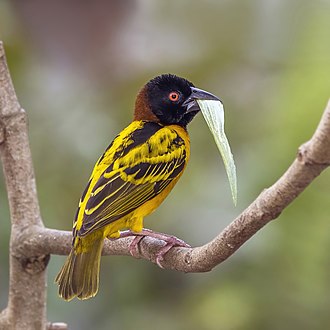
Village Weaver
Ploceus cucullatus

Slender-billed Weaver
Ploceus pelzelni

Lesser Masked-Weaver
Ploceus intermedius

Vieillot's Weaver
Ploceus nigerrimus

Spectacled Weaver
Ploceus ocularis

Holub's Golden-Weaver
Ploceus xanthops

Little Weaver
Ploceus luteolus

Baglafecht Weaver
Ploceus baglafecht

Northern Brown-throated Weaver
Ploceus castanops

Black-necked Weaver
Ploceus nigricollis

Golden-backed Weaver
Ploceus jacksoni
Global Distribution
Warmer areas are where this animal is recorded most often.
Parks Where Found
| # | Park | Country | Daily sighting probability |
|---|---|---|---|
| 1 | Kibale National Park | 🇺🇬 Uganda | |
| 2 | Queen Elizabeth National Park | 🇺🇬 Uganda | |
| 3 | Murchison Falls National Park | 🇺🇬 Uganda | |
| 4 | Virunga National Park | 🇨🇩 Democratic Republic of the Congo | |
| 5 | Bwindi Impenetrable National Park | 🇺🇬 Uganda | |
| 6 | Kidepo Valley National Park | 🇺🇬 Uganda | |
| 7 | Semuliki National Park | 🇺🇬 Uganda | |
| 8 | Lake Mburo National Park | 🇺🇬 Uganda |
Quick answers
What are the chances of seeing a Compact Weaver in Queen Elizabeth National Park?
About 10% of wildlife watchers report a Compact Weaver sighting in Queen Elizabeth National Park, based on 81 verified sightings from GBIF citizen-science data.
When is the best time to see Compact Weaver in Queen Elizabeth National Park?
November has the highest sighting rate for Compact Weaver in Queen Elizabeth National Park in our monthly data.