



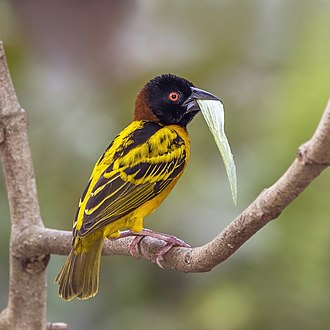
Black-headed Weaver
Ploceus melanocephalus
Silhouette: Sheatherius · PhyloPic
- KingdomAnimalia (Animals)
- PhylumChordata (Chordates)
- ClassAves (Birds)
- OrderPasseriformes (Perching Birds)
- FamilyPloceidae (Weavers and Allies)
- GenusPloceus (Typical Weavers)
- SpeciesPloceus melanocephalus (Black-headed Weaver)
About the Black-headed Weaver
The black-headed weaver (Ploceus melanocephalus), also known as yellow-backed weaver, is a species of bird in the family Ploceidae. It is a resident breeder in damp areas in tropical Africa. The black-headed weaver was formally described in 1758 by the Swedish naturalist Carl Linnaeus in the tenth edition of his Systema Naturae under the binomial name Loxia melanocephala. He specified the type locality as Guinea. Linnaeus based his account on the "Gamboa Groasbeak" that had been described and illustrated in 1750 by the English naturalist Eleazar Albin in his book A Natural History of Birds. Albin had sketched a live specimen belonging to the Duke of Chandos at his country house, Cannons, which was located about 11 mi (18 km) northwest of London near Edgware. The specific epithet melanocephalus, melanocephala combines the Ancient Greek μελας/melas, μελανος/melanos meaning "black" with -κεφαλος/-kephalos meaning "-headed". The black-headed weaver is now one of 67 species placed in the genus Ploceus that was introduced in 1816 by the French naturalist Georges Cuvier.
Five subspecies are recognised: P. m. melanocephalus (Linnaeus, 1758) – Mauritania, Senegal, Gambia, Mali... Wikipedia →
Recent sightings of Black-headed Weaver in Queen Elizabeth National Park
LIVEiNaturalistClosest Relatives at Queen Elizabeth National Park
 Village Weaver
Ploceus cucullatus

Slender-billed Weaver
Ploceus pelzelni

Lesser Masked-Weaver
Ploceus intermedius

Vieillot's Weaver
Ploceus nigerrimus

Spectacled Weaver
Ploceus ocularis

Holub's Golden-Weaver
Ploceus xanthops

Little Weaver
Ploceus luteolus

 Compact Weaver
Ploceus superciliosus

Baglafecht Weaver
Ploceus baglafecht

Northern Brown-throated Weaver
Ploceus castanops

Black-necked Weaver
Ploceus nigricollis

Golden-backed Weaver
Ploceus jacksoni
Global Distribution
Warmer areas are where this animal is recorded most often.
Parks Where Found
| # | Park | Country | Daily sighting probability |
|---|---|---|---|
| 1 | Queen Elizabeth National Park | 🇺🇬 Uganda | |
| 2 | Murchison Falls National Park | 🇺🇬 Uganda | |
| 3 | Kibale National Park | 🇺🇬 Uganda | |
| 4 | Volcanoes National Park | 🇷🇼 Rwanda | |
| 5 | Virunga National Park | 🇨🇩 Democratic Republic of the Congo | |
| 6 | Niokolo-Koba National Park | 🇸🇳 Senegal | |
| 7 | Akagera National Park | 🇷🇼 Rwanda | |
| 8 | Lake Mburo National Park | 🇺🇬 Uganda | |
| 9 | Doñana National Park | 🇪🇸 Spain | |
| 10 | Semuliki National Park | 🇺🇬 Uganda | |
| 11 | Bwindi Impenetrable National Park | 🇺🇬 Uganda | |
| 12 | Nyungwe National Park | 🇷🇼 Rwanda | |
| 13 | Serengeti National Park | 🇹🇿 Tanzania | |
| 14 | Sierra de Guadarrama National Park | 🇪🇸 Spain | |
| 15 | Kidepo Valley National Park | 🇺🇬 Uganda |
Quick answers
What are the chances of seeing a Black-headed Weaver in Queen Elizabeth National Park?
About 40% of wildlife watchers report a Black-headed Weaver sighting in Queen Elizabeth National Park, based on 764 verified sightings from GBIF citizen-science data.
When is the best time to see Black-headed Weaver in Queen Elizabeth National Park?
November has the highest sighting rate for Black-headed Weaver in Queen Elizabeth National Park in our monthly data.