



Orange Bishop
Euplectes franciscanus
Silhouette: Sheatherius · PhyloPic
- KingdomAnimalia (Animals)
- PhylumChordata (Chordates)
- ClassAves (Birds)
- OrderPasseriformes (Perching Birds)
- FamilyPloceidae (Weavers and Allies)
- GenusEuplectes (Bishops and Widowbirds)
- SpeciesEuplectes franciscanus (Orange Bishop)
About the Orange Bishop
The northern red bishop or orange bishop (Euplectes franciscanus) is a small passerine bird in the family Ploceidae. It is part of the largest genus in the family with over 60 different species. Its sister species is the Southern red bishop (Euplectes orix). This species is most recognizable by the bright reddish orange with contrasting black plumage displayed by the breeding male. It is most common throughout the northern African continent but has also been introduced to areas in the western hemisphere.
The northern red bishop was first described by Paul Erdmann Isert in 1789 in Accra, Ghana. Euplectes directly translates to "good weaver," while franciscanus relates to the Franciscans, a religious order from the 12th century that symbolized the crimson color.
The northern red bishop was previously a subspecies of its neighboring species, the southern red bishop (Euplectes orix). Today, these two are classified as separate, distinct species; separated by the equator, the northern red bishop inhabits the northern continent of Africa, while the southern red bishop resides in the south. Molecular phylogenetic data in 2007 supported these two species as having... Wikipedia →
Recent sightings of Orange Bishop in Queen Elizabeth National Park
LIVEiNaturalistClosest Relatives at Queen Elizabeth National Park

 Red Bishop
Euplectes orix

Fan-tailed Widowbird
Euplectes axillaris

White-winged Widowbird
Euplectes albonotatus

Red-collared Widowbird
Euplectes ardens

Black-winged Bishop
Euplectes hordeaceus

Black Bishop
Euplectes gierowii

Yellow-rumped Widowbird
Euplectes capensis

Marsh Widowbird
Euplectes hartlaubi

Yellow-crowned Bishop
Euplectes afer

Yellow-shouldered Widowbird
Euplectes macroura

Black-headed Weaver
Ploceus melanocephalus
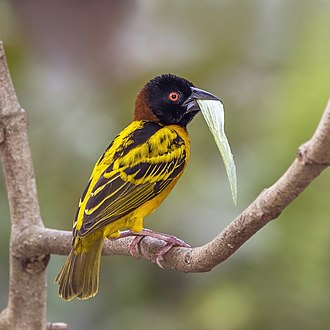
Village Weaver
Ploceus cucullatus
Global Distribution
Warmer areas are where this animal is recorded most often.
Parks Where Found
| # | Park | Country | Daily sighting probability |
|---|---|---|---|
| 1 | Murchison Falls National Park | 🇺🇬 Uganda | |
| 2 | Awash National Park | 🇪🇹 Ethiopia | |
| 3 | Niokolo-Koba National Park | 🇸🇳 Senegal | |
| 4 | Kidepo Valley National Park | 🇺🇬 Uganda | |
| 5 | Queen Elizabeth National Park | 🇺🇬 Uganda | |
| 6 | Kibale National Park | 🇺🇬 Uganda | |
| 7 | Virunga National Park | 🇨🇩 Democratic Republic of the Congo | |
| 8 | Everglades National Park | 🇺🇸 United States | |
| 9 | Lake Mburo National Park | 🇺🇬 Uganda | |
| 10 | Semuliki National Park | 🇺🇬 Uganda |
Quick answers
What are the chances of seeing a Orange Bishop in Queen Elizabeth National Park?
Under 5% of wildlife watchers report a Orange Bishop sighting in Queen Elizabeth National Park, based on 24 verified sightings from GBIF citizen-science data.
When is the best time to see Orange Bishop in Queen Elizabeth National Park?
May has the highest sighting rate for Orange Bishop in Queen Elizabeth National Park in our monthly data.