



Yellow-rumped Widowbird
Euplectes capensis
Silhouette: Sheatherius · PhyloPic
- KingdomAnimalia (Animals)
- PhylumChordata (Chordates)
- ClassAves (Birds)
- OrderPasseriformes (Perching Birds)
- FamilyPloceidae (Weavers and Allies)
- GenusEuplectes (Bishops and Widowbirds)
- SpeciesEuplectes capensis (Yellow-rumped Widowbird)
About the Yellow-rumped Widowbird
The yellow bishop (Euplectes capensis), also known as Cape bishop, Cape widow or yellow-rumped widow, is a resident breeding Afromontane bird species. This common weaver occurs in less arid vegetated areas, such as fynbos, moist grassland and bracken-covered valleys at altitudes from sea level to the Ethiopian Highlands.
In 1760, the French zoologist Mathurin Jacques Brisson included a description of the yellow bishop in his Ornithologie based on a specimen collected from the Cape of Good Hope. He used the French name Le pinçon du Cap de Bonne Espérance and the Latin Fringilla Capitis Bonae Spei. Although Brisson coined Latin names, these do not conform to the binomial system and are not recognised by the International Commission on Zoological Nomenclature. When in 1766 the Swedish naturalist Carl Linnaeus updated his Systema Naturae for the twelfth edition, he added 240 species that had been previously described by Brisson. One of these was the yellow bishop. Linnaeus included a brief description, coined the binomial name Loxia capensis and cited Brisson's work. The specific name capensis denotes the Cape of Good Hope. This species is now placed in the genus Euplectes... Wikipedia →
Recent sightings of Yellow-rumped Widowbird in Queen Elizabeth National Park
LIVEiNaturalistClosest Relatives at Queen Elizabeth National Park

 Red Bishop
Euplectes orix

Fan-tailed Widowbird
Euplectes axillaris

White-winged Widowbird
Euplectes albonotatus

Red-collared Widowbird
Euplectes ardens

Black-winged Bishop
Euplectes hordeaceus

Black Bishop
Euplectes gierowii

Orange Bishop
Euplectes franciscanus

Marsh Widowbird
Euplectes hartlaubi

Yellow-crowned Bishop
Euplectes afer

Yellow-shouldered Widowbird
Euplectes macroura

Black-headed Weaver
Ploceus melanocephalus
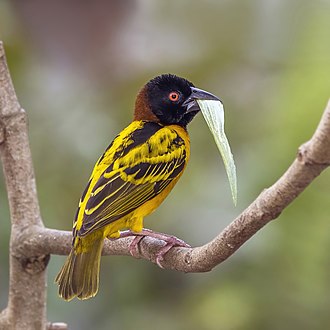
Village Weaver
Ploceus cucullatus
Global Distribution
Warmer areas are where this animal is recorded most often.
Parks Where Found
Quick answers
What are the chances of seeing a Yellow-rumped Widowbird in Queen Elizabeth National Park?
Under 5% of wildlife watchers report a Yellow-rumped Widowbird sighting in Queen Elizabeth National Park, based on 16 verified sightings from GBIF citizen-science data.
When is the best time to see Yellow-rumped Widowbird in Queen Elizabeth National Park?
December has the highest sighting rate for Yellow-rumped Widowbird in Queen Elizabeth National Park in our monthly data.