


Alpine Cricket Frog
Fejervarya limnocharis
- KingdomAnimalia (Animals)
- PhylumChordata (Chordates)
- ClassAmphibia (Amphibians)
- OrderAnura (Frogs and Toads)
- FamilyDicroglossidae (Fork-tongued Frogs)
- GenusFejervarya
- SpeciesFejervarya limnocharis (Alpine Cricket Frog)
About the Alpine Cricket Frog
Fejervarya limnocharis is a species of frog found in South East Asia and parts of Indochina. It is known under many common names, including Boie's wart frog, rice field frog, and Asian grass frog. Molecular studies of the species complex (after Boulenger) suggest that there may be multiple species involved.
Snout pointed, projecting beyond mouth. Canthus obtuse, loreal oblique, more or less concave. Internarial space is longer than interorbital width, which is much less than width of the upper eyelid. Tympanum distinct, half to twothirds the diameter of eye. Fingers obtusely pointed, first longer than second, subarticular tubercles very prominent. Tibiotarsal articulation reaches tympanum or naris. Toes obtuse or with slightly swollen tips, half webbed, subarticular tubercles small and prominent. Body with small tubercles, sometimes small longitudinal folds are present, ventrum smooth except belly and thighs which are granular posteriorly. Male with loose gular region, with brown or blackish W-shaped mark, fore limbs stronger, with pad like subdigital tubercles under first finger. Snout-vent length 39–43 mm.
Color: Gray brown or olive above, sometimes suffused with... Wikipedia →
Closest Relatives at Raja Ampat

Crab-eating Frog
Fejervarya cancrivora

White-lipped Treefrog
Nyctimystes infrafrenatus

Papua Wrinkled Ground Frog
Cornufer papuensis
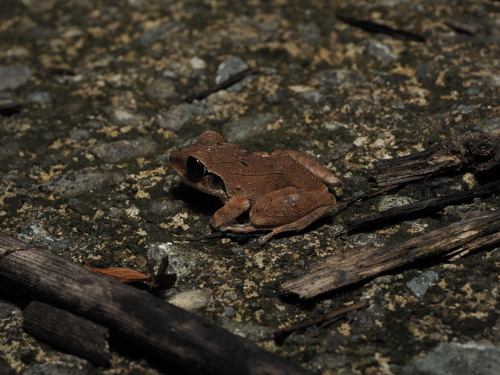
Batanta Wrinkled Ground Frog
Cornufer batantae
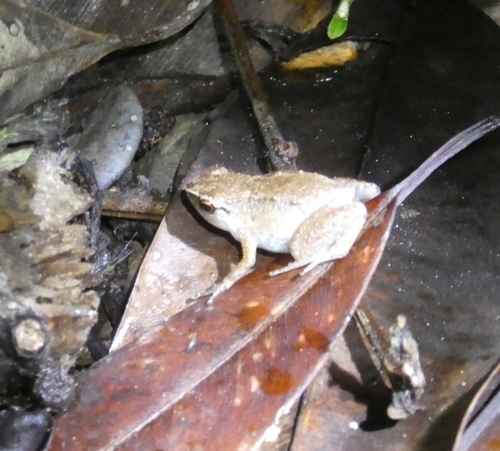
Cophixalus rajampatensis
Cophixalus rajampatensis
New Guinea Bush Frog
Asterophrys turpicola
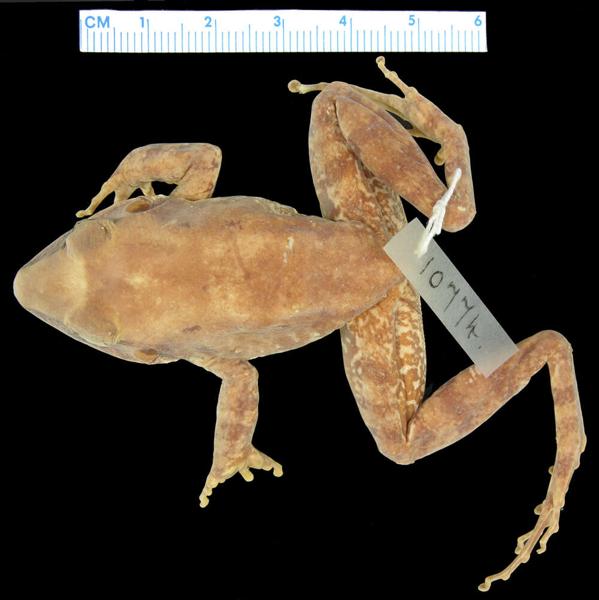
Dotted Wrinkled Ground Frog
Cornufer punctatus

Cophixalus salawatiensis
Cophixalus salawatiensis

Common Indian Toad
Duttaphrynus melanostictus
Wondiwoi Callulops Frog
Asterophrys pullifer
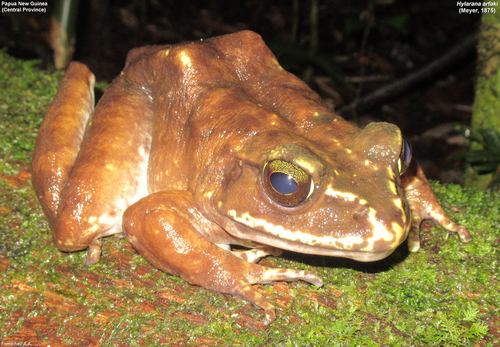
Arfak Mountains Frog
Papurana arfaki

Papua Frog
Papurana papua
Global Distribution
Where this species is recorded worldwide. Restricted to human observations from 2019 onwards — the same kind of record and the same period the probabilities on this page are built from, so collar-tracking studies, camera-trap arrays and museum specimens are excluded. Around Santa Rosa that removes 5,924 GPS fixes from a handful of tagged jaguars.
where this species is recorded (GBIF density — it tracks where observers go, not how likely a sighting is) · parks where it occurs — tap a pin for the sighting probability there
Parks Where Found
| # | Park | Country | Daily sighting probability |
|---|---|---|---|
| 1 | Khao Sok National Park | 🇹🇭 Thailand | |
| 2 | Cat Tien National Park | 🇻🇳 Vietnam | |
| 3 | Kaeng Krachan National Park | 🇹🇭 Thailand | |
| 4 | Danum Valley Conservation Area | 🇲🇾 Malaysia | |
| 5 | Kerinci Seblat National Park | 🇮🇩 Indonesia | |
| 6 | Khao Yai National Park | 🇹🇭 Thailand | |
| 7 | Kinabatangan Wildlife Sanctuary | 🇲🇾 Malaysia | |
| 8 | Gunung Leuser National Park | 🇮🇩 Indonesia | |
| 9 | Doi Inthanon National Park | 🇹🇭 Thailand | |
| 10 | Sepilok | 🇲🇾 Malaysia | |
| 11 | Kinabalu Park | 🇲🇾 Malaysia | |
| 12 | Taroko National Park | 🇹🇼 Taiwan | |
| 13 | Cuc Phuong National Park | 🇻🇳 Vietnam | |
| 14 | Way Kambas National Park | 🇮🇩 Indonesia | |
| 15 | Bali Barat National Park | 🇮🇩 Indonesia | |
| 16 | Taman Negara National Park | 🇲🇾 Malaysia | |
| 17 | Raja Ampat | 🇮🇩 Indonesia |