


Flat-tailed House Gecko
Hemidactylus platyurus
- KingdomAnimalia (Animals)
- PhylumChordata (Chordates)
- ClassSquamata
- FamilyGekkonidae (Typical Geckos)
- GenusHemidactylus (House Geckos)
- SpeciesHemidactylus platyurus (Flat-tailed House Gecko)
About the Flat-tailed House Gecko
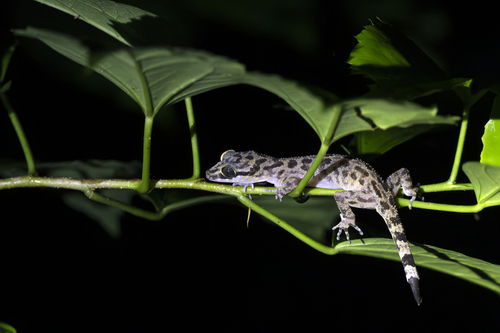
The flat-tailed house gecko (Hemidactylus platyurus), also known as the frilled house gecko or Asian house gecko, is a species of Gekkonidae native to southeastern and southern Asia. The species is sometimes classified under the genus Cosymbotus.
These geckos exhibit patagia in the trunk, tail, and femoral region that are employed in gliding. Similarly to gliding geckos of the genus Gekko (formerly Ptychozoon), these patagia are derived from expansion of fat in the sides.
Snout longer than the distance between the eye and the ear opening, one time and a half the diameter of the orbit; forehead concave; ear-opening small, oval, oblique. Rostral four-sided, not twice as broad as high, with median cleft above; nostril bordered by the rostral, the first labial and three nasals. Nine to eleven upper and seven or eight lower labials; mental large. triangular or pentagonal; two pair of chin-shields, the median pair large, in contact with each other, the posterior pair small, sometimes separated from the labials. Body depressed, covered above with uniform small granules, largest on the snout; a dermal expansion from axilla to groin and another along the... Wikipedia →
Closest Relatives at Raja Ampat

Common House Gecko
Hemidactylus frenatus

Mourning Gecko
Lepidodactylus lugubris
Papua Bow-fingered Gecko
Cyrtodactylus papuensis

Lined Gecko
Gekko vittatus
Batanta Bent-toed Gecko
Cyrtodactylus zugi
Papua Dtella
Gehyra papuana
West Irian Bent-toed Gecko
Cyrtodactylus irianjayaensis
Salawati Scaly-toed Gecko
Lepidodactylus pollostos

Common Dwarf Gecko
Hemiphyllodactylus typus

Pelagic Gecko
Nactus pelagicus

Pacific Dtella
Gehyra oceanica
Global Distribution
Where this species is recorded worldwide. Restricted to human observations from 2019 onwards — the same kind of record and the same period the probabilities on this page are built from, so collar-tracking studies, camera-trap arrays and museum specimens are excluded. Around Santa Rosa that removes 5,924 GPS fixes from a handful of tagged jaguars.
where this species is recorded (GBIF density — it tracks where observers go, not how likely a sighting is) · parks where it occurs — tap a pin for the sighting probability there
Parks Where Found
| # | Park | Country | Daily sighting probability |
|---|---|---|---|
| 1 | Khao Sok National Park | 🇹🇭 Thailand | |
| 2 | Danum Valley Conservation Area | 🇲🇾 Malaysia | |
| 3 | Cat Tien National Park | 🇻🇳 Vietnam | |
| 4 | Kinabatangan Wildlife Sanctuary | 🇲🇾 Malaysia | |
| 5 | Khao Yai National Park | 🇹🇭 Thailand | |
| 6 | Kaeng Krachan National Park | 🇹🇭 Thailand | |
| 7 | Sepilok | 🇲🇾 Malaysia | |
| 8 | Bali Barat National Park | 🇮🇩 Indonesia | |
| 9 | Kinabalu Park | 🇲🇾 Malaysia | |
| 10 | Khao Luang National Park | 🇹🇭 Thailand | |
| 11 | Gunung Leuser National Park | 🇮🇩 Indonesia | |
| 12 | Kerinci Seblat National Park | 🇮🇩 Indonesia | |
| 13 | Doi Inthanon National Park | 🇹🇭 Thailand | |
| 14 | Taman Negara National Park | 🇲🇾 Malaysia | |
| 15 | Tangkoko Nature Reserve | 🇮🇩 Indonesia | |
| 16 | Raja Ampat | 🇮🇩 Indonesia | |
| 17 | Khangchendzonga National Park | 🇮🇳 India | |
| 18 | Namdapha National Park | 🇮🇳 India | |
| 19 | Tanjung Puting National Park | 🇮🇩 Indonesia | |
| 20 | Bako National Park | 🇲🇾 Malaysia | |
| 21 | Yala National Park | 🇱🇰 Sri Lanka | |
| 22 | Everglades National Park | 🇺🇸 United States |
Quick answers
What are the chances of seeing a Flat-tailed House Gecko in Raja Ampat?
About 10% of wildlife watchers report a Flat-tailed House Gecko sighting in Raja Ampat, based on 9 verified sightings from GBIF citizen-science data.
When is the best time to see Flat-tailed House Gecko in Raja Ampat?
November has the highest sighting rate for Flat-tailed House Gecko in Raja Ampat in our monthly data.