


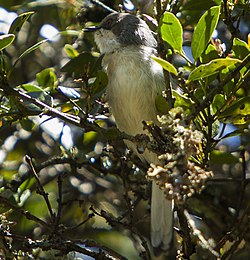

Gray Apalis
Apalis cinerea
Silhouette: Sheatherius · PhyloPic
- KingdomAnimalia (Animals)
- PhylumChordata (Chordates)
- ClassAves (Birds)
- OrderPasseriformes (Perching Birds)
- FamilyCisticolidae (Cisticolas and Allies)
- GenusApalis (Apalises)
- SpeciesApalis cinerea (Gray Apalis)
About the Gray Apalis
The grey apalis (Apalis cinerea) is a species of bird in the family Cisticolidae. It is found in Angola, Burundi, Cameroon, Democratic Republic of the Congo, Equatorial Guinea, Gabon, Kenya, Nigeria, Rwanda, South Sudan, Sudan, Tanzania, and Uganda. Its natural habitats are tropical dry forest and tropical moist montane forest.
They sing both at night and during the day. Wikipedia →
Recent sightings of Gray Apalis in Semuliki National Park
LIVEiNaturalistClosest Relatives at Semuliki National Park

 Buff-throated Apalis
Apalis rufogularis

Black-throated Apalis
Apalis jacksoni

Chestnut-throated Apalis
Apalis porphyrolaema

Masked Apalis
Apalis binotata

Green-backed Camaroptera
Camaroptera brachyura

Yellow-browed Camaroptera
Camaroptera superciliaris

Winding Cisticola
Cisticola marginatus

Olive-green Camaroptera
Camaroptera chloronota

Banded Prinia
Prinia bairdii

Red-faced Cisticola
Cisticola erythrops

Tawny-flanked Prinia
Prinia subflava

Rufous-crowned Eremomela
Eremomela badiceps
Global Distribution
Warmer areas are where this animal is recorded most often.
Parks Where Found
| # | Park | Country | Daily sighting probability |
|---|---|---|---|
| 1 | Bwindi Impenetrable National Park | 🇺🇬 Uganda | |
| 2 | Aberdare National Park | 🇰🇪 Kenya | |
| 3 | Nyungwe National Park | 🇷🇼 Rwanda | |
| 4 | Virunga National Park | 🇨🇩 Democratic Republic of the Congo | |
| 5 | Kibale National Park | 🇺🇬 Uganda | |
| 6 | Semuliki National Park | 🇺🇬 Uganda | |
| 7 | Masai Mara National Reserve | 🇰🇪 Kenya | |
| 8 | Nairobi National Park | 🇰🇪 Kenya | |
| 9 | Lake Mburo National Park | 🇺🇬 Uganda | |
| 10 | Arusha National Park | 🇹🇿 Tanzania | |
| 11 | Volcanoes National Park | 🇷🇼 Rwanda | |
| 12 | Queen Elizabeth National Park | 🇺🇬 Uganda | |
| 13 | Murchison Falls National Park | 🇺🇬 Uganda | |
| 14 | Ngorongoro Conservation Area | 🇹🇿 Tanzania | |
| 15 | Serengeti National Park | 🇹🇿 Tanzania |
Quick answers
What are the chances of seeing a Gray Apalis in Semuliki National Park?
Under 5% of wildlife watchers report a Gray Apalis sighting in Semuliki National Park, based on 7 verified sightings from GBIF citizen-science data.
When is the best time to see Gray Apalis in Semuliki National Park?
June has the highest sighting rate for Gray Apalis in Semuliki National Park in our monthly data.