


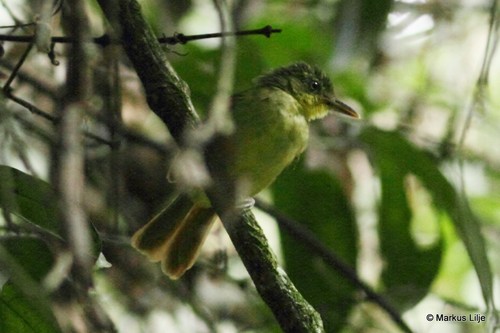
Honeyguide Greenbul
Baeopogon indicator
Silhouette: PhyloPic · PhyloPic
- KingdomAnimalia (Animals)
- PhylumChordata (Chordates)
- ClassAves (Birds)
- OrderPasseriformes (Perching Birds)
- FamilyPycnonotidae (Bulbuls)
- GenusBaeopogon (Honeyguide Greenbuls)
- SpeciesBaeopogon indicator (Honeyguide Greenbul)
About the Honeyguide Greenbul
The honeyguide greenbul (Baeopogon indicator) is a species of songbird in the bulbul family, Pycnonotidae. It is widespread throughout the African tropical rainforest. The honeyguide greenbul was originally described in the genus Criniger and was later re-classified to the genus Baeopogon. Alternate names for the honeyguide greenbul include the honeyguide bulbul and white-tailed greenbul. The latter name is also used as an alternate name by Sjöstedt's greenbul and the swamp palm bulbul.
Two subspecies of the honeyguide greenbul are recognized: Upper Guinea honeyguide greenbul (B. i. leucurus) - (Cassin, 1855): Originally described as a separate species in the genus Trichophorus (a synonym for Criniger). Found from Sierra Leone to Togo
Uganda honeyguide greenbul (B. i. indicator) - (Verreaux, J & Verreaux, E, 1855): Found from Nigeria to southern Sudan and western Kenya, southern Democratic Republic of the Congo, north-western Zambia and northern Angola Wikipedia →
Recent sightings of Honeyguide Greenbul in Semuliki National Park
LIVEiNaturalistClosest Relatives at Semuliki National Park

 Red-tailed Greenbul
Criniger calurus
Xavier's Greenbul
Phyllastrephus xavieri

 Common Bulbul
Pycnonotus barbatus

Little Greenbul
Eurillas virens

Common Bristlebill
Bleda syndactylus

Yellow-whiskered Greenbul
Eurillas latirostris

Toro Olive-Greenbul
Phyllastrephus hypochloris

Joyful Greenbul
Chlorocichla laetissima

Icterine Greenbul
Phyllastrephus icterinus

Slender-billed Greenbul
Stelgidillas gracilirostris

Gray Greenbul
Eurillas gracilis

Swamp Greenbul
Thescelocichla leucopleura
Global Distribution
Warmer areas are where this animal is recorded most often.
Parks Where Found
| # | Park | Country | Daily sighting probability |
|---|---|---|---|
| 1 | Bwindi Impenetrable National Park | 🇺🇬 Uganda | |
| 2 | Kibale National Park | 🇺🇬 Uganda | |
| 3 | Semuliki National Park | 🇺🇬 Uganda | |
| 4 | Virunga National Park | 🇨🇩 Democratic Republic of the Congo | |
| 5 | Murchison Falls National Park | 🇺🇬 Uganda | |
| 6 | Queen Elizabeth National Park | 🇺🇬 Uganda | |
| 7 | Kafue National Park | 🇿🇲 Zambia |
Quick answers
What are the chances of seeing a Honeyguide Greenbul in Semuliki National Park?
About 10% of wildlife watchers report a Honeyguide Greenbul sighting in Semuliki National Park, based on 45 verified sightings from GBIF citizen-science data.
When is the best time to see Honeyguide Greenbul in Semuliki National Park?
December has the highest sighting rate for Honeyguide Greenbul in Semuliki National Park in our monthly data.