



Common Bulbul
Pycnonotus barbatus
Silhouette: Andy Wilson · PhyloPic
- KingdomAnimalia (Animals)
- PhylumChordata (Chordates)
- ClassAves (Birds)
- OrderPasseriformes (Perching Birds)
- FamilyPycnonotidae (Bulbuls)
- GenusPycnonotus (Typical Bulbuls)
- SpeciesPycnonotus barbatus (Common Bulbul)
About the Common Bulbul
The common bulbul (Pycnonotus barbatus) is a member of the bulbul family of passerine birds. It is widespread throughout most of Africa except for the very arid areas, and has recently begun breeding in southernmost Spain. Ten subspecies are recognised based on the geographical variation in plumage. Some of these were formerly considered as separate species: Dodson's bulbul, the Somali bulbul and the dark-capped bulbul.
The common bulbul was formally described and illustrated in 1789 by the French botanist René Desfontaines from a specimen collected near Algiers in Algeria. He placed it with the thrushes in the genus Turdus and coined the binomial name Turdus barbatus. The common bulbul is now one of 31 species placed in the genus Pycnonotus that was introduced in 1826 by the German zoologist Friedrich Boie. The genus name combines the Ancient Greek πυκνος/puknos meaning "thick" or "compact" with -νωτος/-nōtos meaning "-backed". The specific epithet barbatus is Latin meaning bearded. Alternate names for the common bulbul include black-eyed bulbul, black-capped bulbul and common garden bulbul.
Ten subspecies are recognised. Several of these have sometimes... Wikipedia →
Recent sightings of Common Bulbul in Semuliki National Park
LIVEiNaturalistClosest Relatives at Semuliki National Park

 Red-tailed Greenbul
Criniger calurus
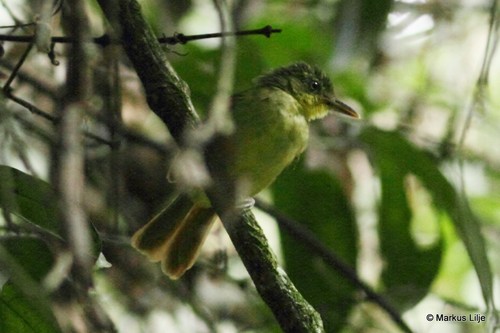
Xavier's Greenbul
Phyllastrephus xavieri

Little Greenbul
Eurillas virens

Common Bristlebill
Bleda syndactylus

Yellow-whiskered Greenbul
Eurillas latirostris

Toro Olive-Greenbul
Phyllastrephus hypochloris

Joyful Greenbul
Chlorocichla laetissima

Icterine Greenbul
Phyllastrephus icterinus

Slender-billed Greenbul
Stelgidillas gracilirostris

Gray Greenbul
Eurillas gracilis

Swamp Greenbul
Thescelocichla leucopleura

Honeyguide Greenbul
Baeopogon indicator
Global Distribution
Warmer areas are where this animal is recorded most often.
Parks Where Found
Quick answers
What are the chances of seeing a Common Bulbul in Semuliki National Park?
About 50% of wildlife watchers report a Common Bulbul sighting in Semuliki National Park, based on 292 verified sightings from GBIF citizen-science data.
When is the best time to see Common Bulbul in Semuliki National Park?
March has the highest sighting rate for Common Bulbul in Semuliki National Park in our monthly data.