


Little Tern
Sternula albifrons
- KingdomAnimalia (Animals)
- PhylumChordata (Chordates)
- ClassAves (Birds)
- OrderCharadriiformes (Shorebirds and Allies)
- FamilyLaridae (Gulls, Terns, and Skimmers)
- GenusSternula (Small Terns)
- SpeciesSternula albifrons (Little Tern)
About the Little Tern
The little tern (Sternula albifrons) is a small seabird of the family Laridae. It is widely distributed breeding on the coasts and inland waterways of Europe, Asia, north and west Africa, and eastern Australia. It winters in the subtropical and tropical oceans as far south as South Africa and Australia.
The little tern was formally described in a sales catalogue by the German naturalist Peter Simon Pallas in 1764 under the binomial name Sterna albifrons. The type locality is Holland in the Netherlands. The species was moved to the genus Sternula when the genus Sterna was restricted to the larger typical terns. The genus name Sternula is a diminutive of Sterna, 'tern', while the specific name albifrons is from Latin albus, 'white', and frons, 'forehead'.
Four subspecies are recognised: S. a. albifrons (Pallas, PS, 1764) – breeds Europe and northern Africa to central Asia; winters to African coast and to western India S. a. guineae (Bannerman, DA, 1931) – breeds coast and Niger River basin, Mauritania to Gabon, and northern Kenya
S. a. placens Gould, J, 1871 – breeds coastal eastern Australia including Tasmania; ranges to Indonesia S. a. sinensis (Gmelin, JF, 1789) – resident... Wikipedia →
Closest Relatives at Tangkoko Nature Reserve

Black-naped Tern
Sterna sumatrana

Whiskered Tern
Chlidonias hybrida

White-winged Tern
Chlidonias leucopterus

Common Tern
Sterna hirundo
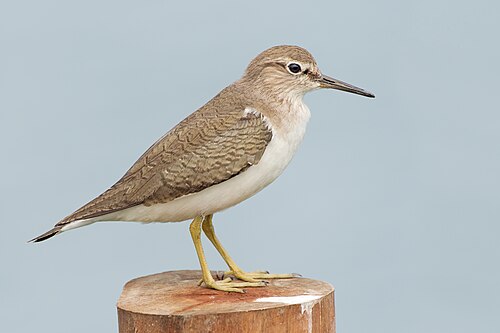
Common Sandpiper
Actitis hypoleucos

Kentish Plover
Charadrius alexandrinus

Whimbrel
Numenius phaeopus

Beach Thick-knee
Esacus magnirostris

Barred Buttonquail
Turnix suscitator

White-headed Stilt
Himantopus leucocephalus

Black-bellied Plover
Pluvialis squatarola

Grey-tailed Tattler
Tringa brevipes
Global Distribution
Where this species is recorded worldwide. Restricted to human observations from 2019 onwards — the same kind of record and the same period the probabilities on this page are built from, so collar-tracking studies, camera-trap arrays and museum specimens are excluded. Around Santa Rosa that removes 5,924 GPS fixes from a handful of tagged jaguars.
where this species is recorded (GBIF density — it tracks where observers go, not how likely a sighting is) · parks where it occurs — tap a pin for the sighting probability there