


Hair-crested Drongo
Dicrurus hottentottus
- KingdomAnimalia (Animals)
- PhylumChordata (Chordates)
- ClassAves (Birds)
- OrderPasseriformes (Perching Birds)
- FamilyDicruridae (Drongos)
- GenusDicrurus (Drongos)
- SpeciesDicrurus hottentottus (Hair-crested Drongo)
About the Hair-crested Drongo
The hair-crested drongo (Dicrurus hottentottus) is an Asian bird of the family Dicruridae. This species was formerly considered conspecific with Dicrurus bracteatus, for which the name "spangled drongo" – formerly used for both – is now usually reserved. Some authorities include the Sumatran drongo (D. sumatranus) in D. hottentottus as subspecies.
It is native from Pakistan, Bangladesh, India, and Bhutan through Indochina to China, Indonesia, and Brunei. Hair-crested drongos move in small flocks and are very noisy. The "spangled drongo", Dicrurus bracteatus, is native on the east coast of Australia and its name is a pejorative slang for a silly person. This may be due to its strange chattering and cackling.
In 1760, French zoologist Mathurin Jacques Brisson included a description of the hair-crested drongo in his Ornithologie based on a specimen that he mistakenly believed had been collected from the Cape of Good Hope in South Africa. He used the French name Le choucas du Cap de Bonne Espérance and the Latin Monedula Capitis Bonae Spei. Although Brisson coined Latin names, these do not conform to the binomial system and are not recognised by the International Commission... Wikipedia →
Closest Relatives at Tanjung Puting National Park

Greater Racket-tailed Drongo
Dicrurus paradiseus

Bronzed Drongo
Dicrurus aeneus

Malaysian Pied-Fantail
Rhipidura javanica

Black-and-red Broadbill
Cymbirhynchus macrorhynchos

Olive-winged Bulbul
Pycnonotus plumosus
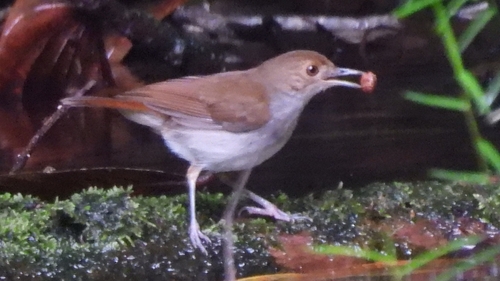
White-chested Babbler
Trichastoma rostratum

Little Spiderhunter
Arachnothera longirostra

Slender-billed Crow
Corvus enca

Van Hasselt's Sunbird
Leptocoma brasiliana

Malaysian Blue-Flycatcher
Cyornis turcosus

Black-winged Flycatcher-shrike
Hemipus hirundinaceus

Green Iora
Aegithina viridissima
Global Distribution
Where this species is recorded worldwide. Restricted to human observations from 2019 onwards — the same kind of record and the same period the probabilities on this page are built from, so collar-tracking studies, camera-trap arrays and museum specimens are excluded. Around Santa Rosa that removes 5,924 GPS fixes from a handful of tagged jaguars.
where this species is recorded (GBIF density — it tracks where observers go, not how likely a sighting is) · parks where it occurs — tap a pin for the sighting probability there