


Little Spiderhunter
Arachnothera longirostra
- KingdomAnimalia (Animals)
- PhylumChordata (Chordates)
- ClassAves (Birds)
- OrderPasseriformes (Perching Birds)
- FamilyNectariniidae (Sunbirds and Spiderhunters)
- GenusArachnothera (Typical Spiderhunters)
- SpeciesArachnothera longirostra (Little Spiderhunter)
About the Little Spiderhunter
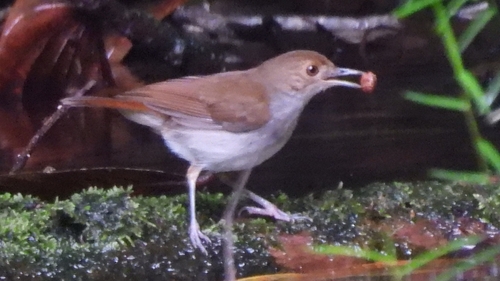
The little spiderhunter (Arachnothera longirostra) is a species of long-billed nectar-feeding bird in the family Nectariniidae found in the moist forests of South and Southeast Asia. Unlike typical sunbirds, males and females are very similar in plumage. They are usually seen in ones or twos and frequently make a tzeck call. They are most often found near flowering plants where they obtain nectar.
The distinctive long beak set it apart from other sunbirds. The sexes are similar, except that the female has a paler base on the lower mandible. Male has all black beak. They are found near their favourite nectar bearing trees, often species of wild Musaceae or flowers in gardens. They have a buzzy zick-zick call that is made regularly when disturbed or when foraging. Additionally, the song is series of rapid chipping notes and these can go on for long periods.
The genus name Arachnothera means "spider hunter" and the species epithet refers to the long beak. About thirteen geographic races are recognized. The nominate race longirostra (Latham, 1790) is found in southwestern India, central and northeastern India, foothills of the Himalayas and into Thailand... Wikipedia →
Closest Relatives at Tanjung Puting National Park

Long-billed Spiderhunter
Arachnothera robusta

Spectacled Spiderhunter
Arachnothera flavigaster

Van Hasselt's Sunbird
Leptocoma brasiliana

Ruby-cheeked Sunbird
Chalcoparia singalensis

Copper-throated Sunbird
Leptocoma calcostetha

Crimson Sunbird
Aethopyga siparaja

Brown-throated Sunbird
Anthreptes malacensis

Plain Sunbird
Anthreptes simplex

Malaysian Pied-Fantail
Rhipidura javanica

Black-and-red Broadbill
Cymbirhynchus macrorhynchos

Olive-winged Bulbul
Pycnonotus plumosus
White-chested Babbler
Trichastoma rostratum
Global Distribution
Where this species is recorded worldwide. Restricted to human observations from 2019 onwards — the same kind of record and the same period the probabilities on this page are built from, so collar-tracking studies, camera-trap arrays and museum specimens are excluded. Around Santa Rosa that removes 5,924 GPS fixes from a handful of tagged jaguars.
where this species is recorded (GBIF density — it tracks where observers go, not how likely a sighting is) · parks where it occurs — tap a pin for the sighting probability there
Parks Where Found
Quick answers
What are the chances of seeing a Little Spiderhunter in Tanjung Puting National Park?
About 30% of wildlife watchers report a Little Spiderhunter sighting in Tanjung Puting National Park, based on 54 verified sightings from GBIF citizen-science data.
When is the best time to see Little Spiderhunter in Tanjung Puting National Park?
June has the highest sighting rate for Little Spiderhunter in Tanjung Puting National Park in our monthly data.