


Scarlet-backed Flowerpecker
Dicaeum cruentatum
- KingdomAnimalia (Animals)
- PhylumChordata (Chordates)
- ClassAves (Birds)
- OrderPasseriformes (Perching Birds)
- FamilyDicaeidae (Flowerpeckers)
- GenusDicaeum (Typical Flowerpeckers)
- SpeciesDicaeum cruentatum (Scarlet-backed Flowerpecker)
About the Scarlet-backed Flowerpecker
The scarlet-backed flowerpecker (Dicaeum cruentatum) is a species of passerine bird in the flowerpecker family Dicaeidae. Sexually dimorphic, the male has navy blue upperparts with a bright red streak down its back from its crown to its tail coverts, while the female and juvenile are predominantly olive green. It is found in subtropical or tropical moist lowland forests and occasionally gardens in a number of countries throughout South and East Asia.
In 1747 the English naturalist George Edwards included an illustration and a description of the scarlet-backed flowerpecker in the second volume of his A Natural History of Uncommon Birds. He used the English name "The little Black, White, and Red Indian Creeper". Edwards based his hand-coloured etching on a preserved specimen that had been sent from Bengal to the silk-pattern designer and naturalist Joseph Dandridge in London. When in 1758 the Swedish naturalist Carl Linnaeus updated his Systema Naturae for the tenth edition, he placed the scarlet-backed flowerpecker with the treecreepers in the genus Certhia. Linnaeus included a brief description, coined the binomial name Certhia cruentata and cited Edwards' work. The scarlet... Wikipedia →
Closest Relatives at Tanjung Puting National Park

Orange-bellied Flowerpecker
Dicaeum trigonostigma

Scarlet-headed Flowerpecker
Dicaeum trochileum

Plain Flowerpecker
Dicaeum minullum

Crimson-breasted Flowerpecker
Prionochilus percussus

Yellow-breasted Flowerpecker
Prionochilus maculatus

Scarlet-breasted Flowerpecker
Prionochilus thoracicus

Yellow-rumped Flowerpecker
Prionochilus xanthopygius

Malaysian Pied-Fantail
Rhipidura javanica

Black-and-red Broadbill
Cymbirhynchus macrorhynchos

Olive-winged Bulbul
Pycnonotus plumosus
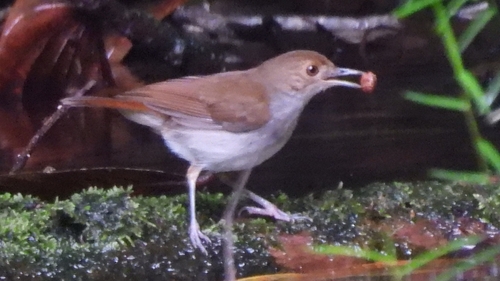
White-chested Babbler
Trichastoma rostratum

Little Spiderhunter
Arachnothera longirostra
Global Distribution
Where this species is recorded worldwide. Restricted to human observations from 2019 onwards — the same kind of record and the same period the probabilities on this page are built from, so collar-tracking studies, camera-trap arrays and museum specimens are excluded. Around Santa Rosa that removes 5,924 GPS fixes from a handful of tagged jaguars.
where this species is recorded (GBIF density — it tracks where observers go, not how likely a sighting is) · parks where it occurs — tap a pin for the sighting probability there
Parks Where Found
| # | Park | Country | Daily sighting probability |
|---|---|---|---|
| 1 | Khao Sok National Park | 🇹🇭 Thailand | |
| 2 | Cat Tien National Park | 🇻🇳 Vietnam | |
| 3 | Kaeng Krachan National Park | 🇹🇭 Thailand | |
| 4 | Kaziranga National Park | 🇮🇳 India | |
| 5 | Khao Luang National Park | 🇹🇭 Thailand | |
| 6 | Sepilok | 🇲🇾 Malaysia | |
| 7 | Doi Inthanon National Park | 🇹🇭 Thailand | |
| 8 | Khao Yai National Park | 🇹🇭 Thailand | |
| 9 | Gunung Leuser National Park | 🇮🇩 Indonesia | |
| 10 | Sundarbans National Park | 🇮🇳 India | |
| 11 | Manas National Park | 🇮🇳 India | |
| 12 | Tanjung Puting National Park | 🇮🇩 Indonesia | |
| 13 | Cuc Phuong National Park | 🇻🇳 Vietnam | |
| 14 | Kinabatangan Wildlife Sanctuary | 🇲🇾 Malaysia | |
| 15 | Way Kambas National Park | 🇮🇩 Indonesia | |
| 16 | Kerinci Seblat National Park | 🇮🇩 Indonesia | |
| 17 | Royal Manas National Park | 🇧🇹 Bhutan | |
| 18 | Danum Valley Conservation Area | 🇲🇾 Malaysia | |
| 19 | Kinabalu Park | 🇲🇾 Malaysia | |
| 20 | Taman Negara National Park | 🇲🇾 Malaysia | |
| 21 | Bako National Park | 🇲🇾 Malaysia |
Quick answers
What are the chances of seeing a Scarlet-backed Flowerpecker in Tanjung Puting National Park?
About 10% of wildlife watchers report a Scarlet-backed Flowerpecker sighting in Tanjung Puting National Park, based on 9 verified sightings from GBIF citizen-science data.
When is the best time to see Scarlet-backed Flowerpecker in Tanjung Puting National Park?
June has the highest sighting rate for Scarlet-backed Flowerpecker in Tanjung Puting National Park in our monthly data.