


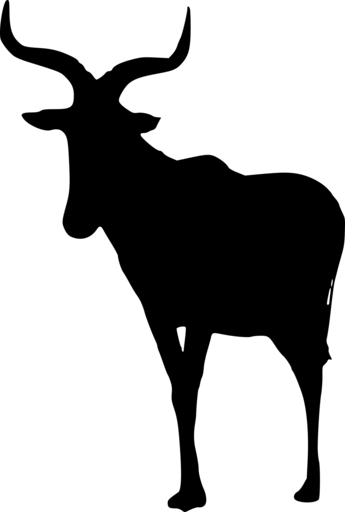
Hartebeest
Alcelaphus buselaphus
Silhouette: TeaandBiology · PhyloPic
- KingdomAnimalia (Animals)
- PhylumChordata (Chordates)
- ClassMammalia (Mammals)
- OrderArtiodactyla (Even-toed Ungulates and Cetaceans)
- FamilyBovidae (Bovids)
- GenusAlcelaphus (Hartebeests)
- SpeciesAlcelaphus buselaphus (Hartebeest)
About the Hartebeest
The hartebeest (Alcelaphus buselaphus), also known as kongoni or kaama, is an African antelope. It is the only member of the genus Alcelaphus. Eight subspecies have been described, including two sometimes considered to be independent species. A large antelope, the hartebeest stands just over 1 m (3 ft 3 in) at the shoulder, and has a typical head-and-body length of 2 to 2.50 m (6 ft 7 in to 8 ft 2 in). The weight ranges from 100 to 200 kg (220 to 440 lb). It has a particularly elongated forehead and oddly-shaped horns, a short neck, and pointed ears. Its legs, which often have black markings, are unusually long. The coat is generally short and shiny. Coat colour varies by the subspecies, from the sandy brown of the western hartebeest to the chocolate brown of the Swayne's hartebeest. Both sexes of all subspecies have horns, with those of females being slenderer. Horns can reach lengths of 45–70 cm (18–28 in). Apart from its long face, the large chest and the sharply sloping back differentiate the hartebeest from other antelopes. A conspicuous hump over the shoulders is due to the long dorsal processes of the vertebrae in this region.
Gregarious animals, hartebeest form herds of 20 to 300 individuals. They are very alert and non-aggressive. They are primarily grazers, with their diets consisting mainly of grasses. Mating in hartebeest takes place throughout the year with one or two peaks, and depends upon the subspecies and local factors. Both males and females reach sexual maturity at one to two years of age. Gestation is eight to nine months long, after which a single calf is born. Births usually peak in the dry season. The lifespan is 12 to 15 years.
Inhabiting dry savannas and wooded grasslands, hartebeest often move to more arid places after rainfall. They have been reported from altitudes on Mount Kenya up to 4,000 m (13,000 ft). The hartebeest was formerly widespread in Africa, but populations have undergone a drastic decline due to habitat destruction, hunting, human settlement, and competition with livestock for food. Each of the eight subspecies of the hartebeest has a different conservation status. The Bubal hartebeest was declared extinct by the International Union for Conservation of Nature (IUCN) in 1994. While the populations of the red hartebeest are on the rise, those of the Tora hartebeest, already Critically Endangered, are falling. The hartebeest is extinct in Algeria, Egypt, Lesotho, Libya, Morocco, Somalia, and Tunisia; but has been introduced into Eswatini and Zimbabwe. It is a popular game animal due to its highly regarded meat. Wikipedia →
Recent sightings of Hartebeest in Tarangire National Park
LIVEiNaturalistClosest Relatives at Tarangire National Park

 Impala
Aepyceros melampus

 Waterbuck
Kobus ellipsiprymnus

Blue Wildebeest
Connochaetes taurinus

 African Buffalo
Syncerus caffer

 Common Eland
Taurotragus oryx

 Bohor Reedbuck
Redunca redunca

 Grant's Gazelle
Nanger granti

 Northern Bushbuck
Tragelaphus scriptus

 Lesser Kudu
Tragelaphus imberbis

 East African Oryx
Oryx beisa

Greater Kudu
Tragelaphus strepsiceros

Thomson's Gazelle
Eudorcas thomsonii
Global Distribution
Warmer areas are where this animal is recorded most often.
Parks Where Found
Quick answers
What are the chances of seeing a Hartebeest in Tarangire National Park?
About 20% of wildlife watchers report a Hartebeest sighting in Tarangire National Park, based on 19 verified sightings from GBIF citizen-science data.
When is the best time to see Hartebeest in Tarangire National Park?
February has the highest sighting rate for Hartebeest in Tarangire National Park in our monthly data.