
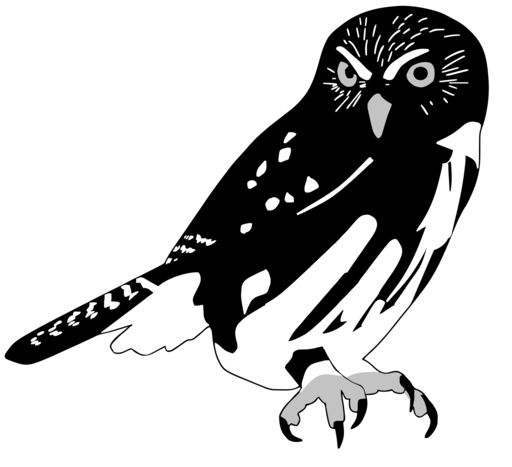
Central American Pygmy-Owl
Glaucidium griseiceps
Silhouette: Edwin Price · PhyloPic
- KingdomAnimalia (Animals)
- PhylumChordata (Chordates)
- ClassAves (Birds)
- OrderStrigiformes (Owls)
- FamilyStrigidae (Typical Owls)
- GenusGlaucidium (Pygmy-Owls and Typical Owlets)
- SpeciesGlaucidium griseiceps (Central American Pygmy-Owl)
About the Central American Pygmy-Owl
The Central American pygmy owl (Glaucidium griseiceps) is a species of owl in the family Strigidae. It is found in Belize, Colombia, Costa Rica, Ecuador, Guatemala, Honduras, Mexico, Nicaragua, and Panama. The International Ornithological Committee (IOC) treats the Central American pygmy owl as monotypic. However, the Clements taxonomy and Handbook of the Birds of the World recognize three subspecies, the nominate Glaucidium griseiceps, G. g. occultum, and G. g. rarum.
The Central American pygmy owl is 13 to 18 cm (5.1 to 7.1 in) long. Males weigh 50.6 to 58.8 g (1.78 to 2.07 oz) and females about 56 g (2.0 oz). Adults' crown and nape are grayish brown; the crown has buff to whitish spots and the nape dark "false eyes". Their upperparts and tail are rich brown and the tail has pale bars across it. Their underparts are whitish with reddish brown streaks. The juvenile's crown and nape are gray; the crown is unspotted and the nape's false eyes are sooty.
The Central American pygmy owl is found from Veracruz, Oaxaca, and Chiapas in southern Mexico through Guatemala, Belize, Honduras, Costa Rica, and Panama into... Wikipedia →
Recent sightings of Central American Pygmy-Owl in Tenorio Volcano National Park
LIVEiNaturalistClosest Relatives at Tenorio Volcano National Park

 Ferruginous Pygmy-Owl
Glaucidium brasilianum

 Crested Owl
Lophostrix cristata

Spectacled Owl
Pulsatrix perspicillata

 Black-White Owl
Strix nigrolineata

Mottled Owl
Strix virgata

Striped Owl
Pseudoscops clamator

 Pacific Screech-Owl
Megascops cooperi

Vermiculated Screech-Owl
Megascops guatemalae

American Barn Owl
Tyto furcata
Global Distribution
Warmer areas are where this animal is recorded most often.
Parks Where Found
| # | Park | Country | Daily sighting probability |
|---|---|---|---|
| 1 | Montes Azules Biosphere Reserve | 🇲🇽 Mexico | |
| 2 | Gandoca-Manzanillo Wildlife Refuge | 🇨🇷 Costa Rica | |
| 3 | Darién National Park | 🇵🇦 Panama | |
| 4 | Pico Bonito National Park | 🇭🇳 Honduras | |
| 5 | Braulio Carrillo National Park | 🇨🇷 Costa Rica | |
| 6 | Tenorio Volcano National Park | 🇨🇷 Costa Rica | |
| 7 | Tortuguero National Park | 🇨🇷 Costa Rica | |
| 8 | La Amistad International Park (Panama) | 🇵🇦 Panama | |
| 9 | Cahuita National Park | 🇨🇷 Costa Rica | |
| 10 | Rincón de la Vieja National Park | 🇨🇷 Costa Rica | |
| 11 | Cockscomb Basin Wildlife Sanctuary | 🇧🇿 Belize | |
| 12 | Tikal National Park | 🇬🇹 Guatemala | |
| 13 | Chagres National Park | 🇵🇦 Panama | |
| 14 | Bastimentos Island National Marine Park | 🇵🇦 Panama | |
| 15 | Soberanía National Park | 🇵🇦 Panama |
Quick answers
What are the chances of seeing a Central American Pygmy-Owl in Tenorio Volcano National Park?
Under 5% of wildlife watchers report a Central American Pygmy-Owl sighting in Tenorio Volcano National Park, based on 16 verified sightings from GBIF citizen-science data.
When is the best time to see Central American Pygmy-Owl in Tenorio Volcano National Park?
October has the highest sighting rate for Central American Pygmy-Owl in Tenorio Volcano National Park in our monthly data.