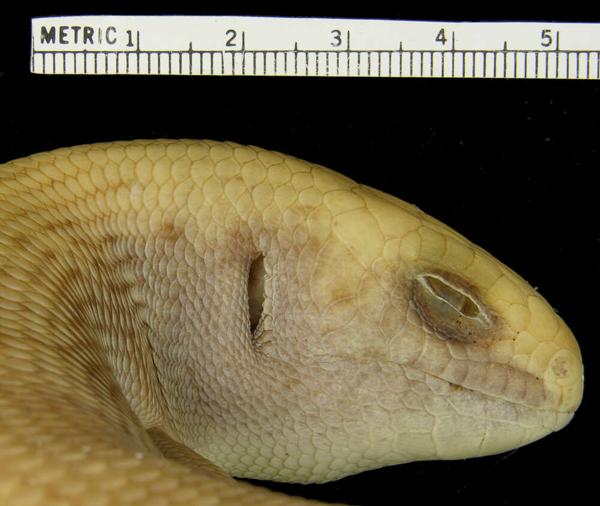

Great Desert Skink
Liopholis kintorei
Silhouette: David Orr · PhyloPic
- KingdomAnimalia (Animals)
- PhylumChordata (Chordates)
- ClassSquamata
- FamilyScincidae (Skinks)
- GenusLiopholis (Australian Desert and Rock Skinks)
- SpeciesLiopholis kintorei (Great Desert Skink)
About the Great Desert Skink
The great desert skink (Liopholis kintorei or Egernia kintorei), also known commonly as Kintore's egernia and by various other names including tjakura in various Aboriginal Australian languages, is a species of skink, a lizard in the family Scincidae. The species is native to the western half of Australia. It is a burrowing lizard and extremely social.
The species is known as Liopholis kintorei or Egernia kintorei. The specific name, kintorei, is in honour of Algernon Keith-Falconer, 9th Earl of Kintore, a British politician who was a colonial governor of South Australia.
One of the common name of this skink is great desert skink. Aboriginal Australian names for the skink include tjakura, mulyamiji, tjalapa, warrana (also spelt warrarna), and nampu. The great desert skink is a medium-sized skink, reaching an average snout-to-vent length (SVL) of 19–20 cm (7.5–7.9 in), weighing around 350 g (12 oz). It has smooth, small, glossy scales and is mostly rust-coloured on the top of the body, with the belly a vanilla colour. It has relatively large circular eyes and a short snout.
They can be distinguished from Egernia striolata because they... Wikipedia →
Recent sightings of Great Desert Skink in Uluru-Kata Tjuta National Park
LIVEiNaturalistClosest Relatives at Uluru-Kata Tjuta National Park

 Leopard Ctenotus
Ctenotus pantherinus

Centralian Bluetongue
Tiliqua multifasciata

Leonhardi's Ctenotus
Ctenotus leonhardii

Shiny-palmed Shining-skink
Cryptoblepharus australis
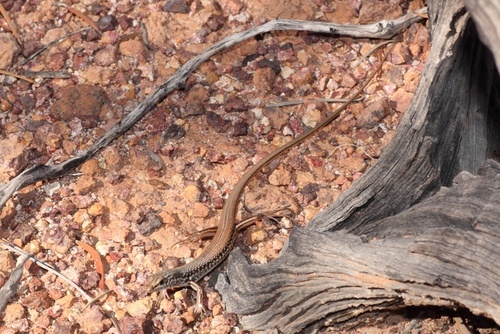
Massive-gibber Ctenotus
Ctenotus septenarius

Desert Rainbow Skink
Carlia triacantha
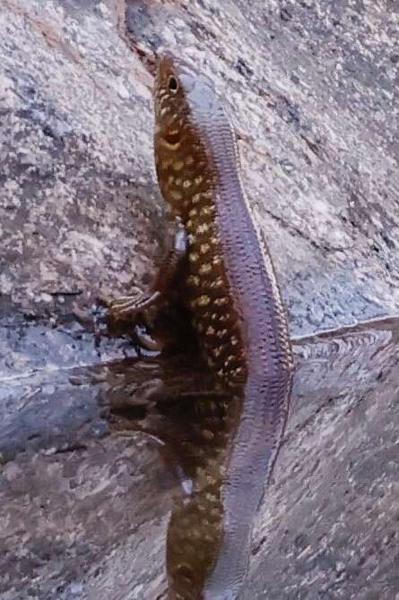
Grand Ctenotus
Ctenotus grandis
Wedgesnout Ctenotus
Ctenotus brooksi
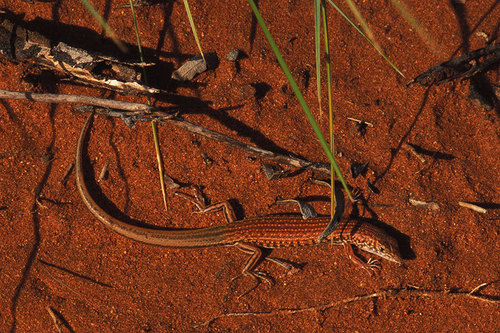
Fine Side-lined Ctenotus
Ctenotus dux

Clay-soil Ctenotus
Ctenotus helenae

Blue-tailed Finesnout Ctenotus
Ctenotus calurus
Fourteen-lined Ctenotus
Ctenotus quattuordecimlineatus
Global Distribution
Warmer areas are where this animal is recorded most often.
Parks Where Found
| # | Park | Country | Daily sighting probability |
|---|---|---|---|
| 1 | Uluru-Kata Tjuta National Park | 🇦🇺 Australia |
More parks will be added in future updates.
Quick answers
What are the chances of seeing a Great Desert Skink in Uluru-Kata Tjuta National Park?
About 20% of wildlife watchers report a Great Desert Skink sighting in Uluru-Kata Tjuta National Park, based on 12 verified sightings from GBIF citizen-science data.
When is the best time to see Great Desert Skink in Uluru-Kata Tjuta National Park?
November has the highest sighting rate for Great Desert Skink in Uluru-Kata Tjuta National Park in our monthly data.