


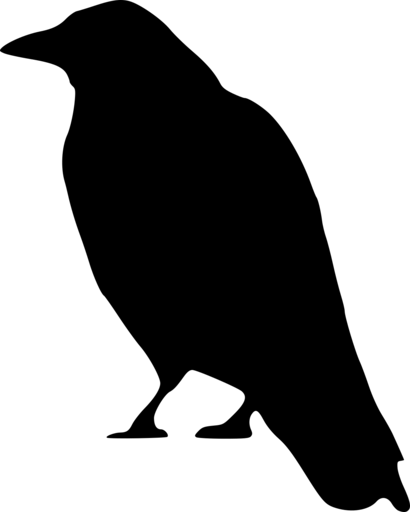
American Crow
Corvus brachyrhynchos
Silhouette: Peileppe · PhyloPic
- KingdomAnimalia (Animals)
- PhylumChordata (Chordates)
- ClassAves (Birds)
- OrderPasseriformes (Perching Birds)
- FamilyCorvidae (Crows, Jays, and Magpies)
- GenusCorvus (Crows and Ravens)
- SpeciesCorvus brachyrhynchos (American Crow)
About the American Crow
The American crow (Corvus brachyrhynchos) is a large passerine bird species of the family Corvidae. It is a common bird found throughout much of North America, only absent from the tundra biome. The American crow is the New World counterpart to the carrion crow and the hooded crow of Eurasia, occupying similar ecological niches.
The American crow has all-black plumage, with iridescent feathers. It looks similar to other all-black corvids. It is highly intelligent, similar to other Corvidae, and is adaptable to human environments. The American crow can be distinguished from the common raven by its smaller size and a slightly less pronounced beak, and from the carrion crow by its size, as the carrion crow is larger and of a stockier build. The American crow can be difficult to distinguish from the fish crow; however, the fish crow tends to fluff its throat feathers when calling. The American crow is an omnivore, feeding on insects, seeds, and nuts while also preying on small animals. It also rarely feeds on carrion, leading to associations with death, thieves, and bad luck in some cultures; however, in Native American and some Gaelic cultures, crows are considered good luck due to their intelligence.
The American crow is common, widespread, and susceptible to the West Nile virus, making it a useful bioindicator for tracking the virus's spread. Direct transmission of the virus from crows to humans is impossible. According to BirdLife International, there are 31 million American crows as of 2012. Wikipedia →
Recent sightings of American Crow in Wrangell-St. Elias National Park
LIVEiNaturalistClosest Relatives at Wrangell-St. Elias National Park

 Common Raven
Corvus corax

 Gray Jay
Perisoreus canadensis

 Black-billed Magpie
Pica hudsonia

 Steller's Jay
Cyanocitta stelleri

 American Robin
Turdus migratorius

 Dark-eyed Junco
Junco hyemalis

 Yellow-rumped Warbler
Setophaga coronata

 Ruby-crowned Kinglet
Regulus calendula

 Orange-crowned Warbler
Leiothlypis celata

 White-crowned Sparrow
Zonotrichia leucophrys

 Savannah Sparrow
Passerculus sandwichensis

 Lincoln's Sparrow
Melospiza lincolnii
Global Distribution
Warmer areas are where this animal is recorded most often.
Parks Where Found
| # | Park | Country | Daily sighting probability |
|---|---|---|---|
| 1 | Acadia National Park | 🇺🇸 United States | |
| 2 | Big Cypress National Preserve | 🇺🇸 United States | |
| 3 | Shenandoah National Park | 🇺🇸 United States | |
| 4 | Point Pelee National Park | 🇨🇦 Canada | |
| 5 | Cape Breton Highlands National Park | 🇨🇦 Canada | |
| 6 | Congaree National Park | 🇺🇸 United States | |
| 7 | Gros Morne National Park | 🇨🇦 Canada | |
| 8 | Everglades National Park | 🇺🇸 United States | |
| 9 | Isle Royale National Park | 🇺🇸 United States | |
| 10 | Kenai Fjords National Park | 🇺🇸 United States | |
| 11 | Joshua Tree National Park | 🇺🇸 United States | |
| 12 | Wood Buffalo National Park | 🇨🇦 Canada | |
| 13 | Katmai National Park | 🇺🇸 United States | |
| 14 | Wrangell-St. Elias National Park | 🇺🇸 United States | |
| 15 | Yosemite National Park | 🇺🇸 United States |
Quick answers
What are the chances of seeing a American Crow in Wrangell-St. Elias National Park?
About 10% of wildlife watchers report a American Crow sighting in Wrangell-St. Elias National Park, based on 24 verified sightings from GBIF citizen-science data.
When is the best time to see American Crow in Wrangell-St. Elias National Park?
December has the highest sighting rate for American Crow in Wrangell-St. Elias National Park in our monthly data.