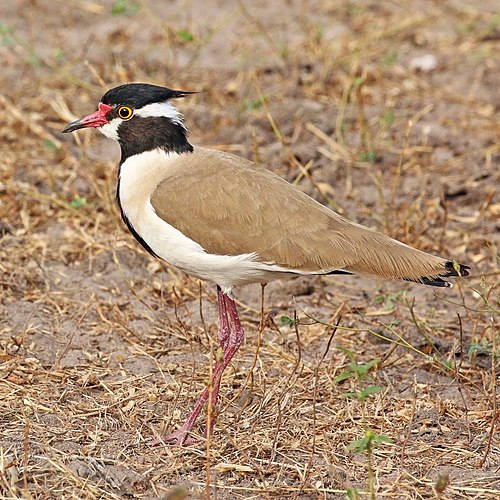


Black-headed Lapwing
Vanellus tectus
Silhouette: Rebecca Groom · PhyloPic
- KingdomAnimalia (Animals)
- PhylumChordata (Chordates)
- ClassAves (Birds)
- OrderCharadriiformes (Shorebirds and Allies)
- FamilyCharadriidae (Plovers and Lapwings)
- GenusVanellus (Lapwings)
- SpeciesVanellus tectus (Black-headed Lapwing)
About the Black-headed Lapwing
The black-headed lapwing or black-headed plover (Vanellus tectus) is a large lapwing, a group of largish waders in the family Charadriidae. It is a resident breeder across sub-Saharan Africa from Senegal to Ethiopia, although it has seasonal movements. It lays two or three eggs on a ground scrape.
These are conspicuous and unmistakable birds. They are medium-large waders with a black head other than a white forehead, lower face and bands across the rear head and nape. There is a wispy black crest like northern lapwing and the bill and legs are red. The tail is white, tipped black.
In flight, the black-headed lapwing's upperwings have black flight feathers and brown coverts separated by a white bar. The underwings are white with black flight feathers. This species is a common breeder in wet lowland habitats close to water. It often feeds in drier habitats, such as golf courses and grassy scrub, picking insects and other invertebrates from the ground.
The black-headed lapwing has a metallic tink-tink call. The black-headed lapwing was described by the French polymath Georges-Louis Leclerc, Comte de Buffon in 1781 in his Histoire Naturelle des Oiseaux from a specimen collected... Wikipedia →
Recent sightings of Black-headed Lapwing in Amboseli National Park
LIVEiNaturalistClosest Relatives at Amboseli National Park

 Blacksmith Lapwing
Vanellus armatus

Crowned Lapwing
Vanellus coronatus

Long-toed Lapwing
Vanellus crassirostris

Spur-winged Lapwing
Vanellus spinosus

African Wattled Lapwing
Vanellus senegallus

 Common Ringed Plover
Charadrius hiaticula

 Caspian Plover
Charadrius asiaticus

 Black-bellied Plover
Pluvialis squatarola

 African Jacana
Actophilornis africanus

 Black-winged Stilt
Himantopus himantopus

 Collared Pratincole
Glareola pratincola

Double-banded Courser
Rhinoptilus africanus
Global Distribution
Warmer areas are where this animal is recorded most often.
Parks Where Found
| # | Park | Country | Daily sighting probability |
|---|---|---|---|
| 1 | Murchison Falls National Park | 🇺🇬 Uganda | |
| 2 | Meru National Park | 🇰🇪 Kenya | |
| 3 | Tsavo East National Park | 🇰🇪 Kenya | |
| 4 | Kidepo Valley National Park | 🇺🇬 Uganda | |
| 5 | Niokolo-Koba National Park | 🇸🇳 Senegal | |
| 6 | Awash National Park | 🇪🇹 Ethiopia | |
| 7 | Tsavo West National Park | 🇰🇪 Kenya | |
| 8 | Amboseli National Park | 🇰🇪 Kenya | |
| 9 | Mkomazi National Park | 🇹🇿 Tanzania | |
| 10 | Queen Elizabeth National Park | 🇺🇬 Uganda | |
| 11 | Kibale National Park | 🇺🇬 Uganda | |
| 12 | Virunga National Park | 🇨🇩 Democratic Republic of the Congo | |
| 13 | Lake Mburo National Park | 🇺🇬 Uganda |
Quick answers
What are the chances of seeing a Black-headed Lapwing in Amboseli National Park?
Under 5% of wildlife watchers report a Black-headed Lapwing sighting in Amboseli National Park, based on 7 verified sightings from GBIF citizen-science data.
When is the best time to see Black-headed Lapwing in Amboseli National Park?
October has the highest sighting rate for Black-headed Lapwing in Amboseli National Park in our monthly data.