



Greater Spear-nosed Bat
Phyllostomus hastatus
Silhouette: Roberto Díaz Sibaja · PhyloPic
- KingdomAnimalia (Animals)
- PhylumChordata (Chordates)
- ClassMammalia (Mammals)
- OrderChiroptera (Bats)
- FamilyPhyllostomidae (New World Leaf-nosed Bats)
- GenusPhyllostomus (Spear-nosed Bats)
- SpeciesPhyllostomus hastatus (Greater Spear-nosed Bat)
About the Greater Spear-nosed Bat
The greater spear-nosed bat (Phyllostomus hastatus) is a bat species of the family Phyllostomidae from South and Central America. It is one of the larger bats of this region and is omnivorous. Phyllostomus hastatus lives in tropical regions of the Americas. The species ranges from Guatemala and Belize south to Peru, Bolivia, Paraguay, northern Argentina and Brazil. It also occurs in Trinidad and Tobago and on Margarita Island (Venezuela). Although most commonly found around streams and other bodies of water, these bats are also present in drier areas. They inhabit both open and forested regions.
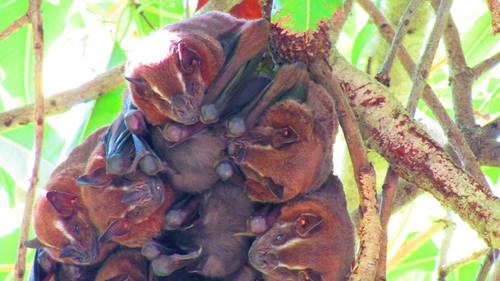
The greater spear-nosed bat has a body length of around 100–130 mm (3.9–5.1 in), with a wing span of 455 mm (17.9 in). Despite the large size, it is very light, weighing on average 81 g (2.9 oz). Its long, thick hair is dark brown, with a slight orange tinge on the ventral side. It has a well-developed nose shaped like a spear-head, which gives it its more common name. The ears are spread far apart and are smaller than in other phyllostomids. The lower lip has a distinctive V-shaped groove and many warts. Both sexes have a throat sac just above breast bone. That... Wikipedia →
Recent sightings of Greater Spear-nosed Bat in Braulio Carrillo National Park
LIVEiNaturalistClosest Relatives at Braulio Carrillo National Park

 pale spear-nosed bat
Phyllostomus discolor

White Bat
Ectophylla alba

Vampire Bat
Desmodus rotundus

 Jamaican Fruit-eating Bat
Artibeus jamaicensis

Striped Yellow-eared Bat
Vampyriscus nymphaea

Northern Little Yellow-eared Bat
Vampyressa thyone

Northern Stripe-headed Round-eared Bat
Tonatia bakeri
Great Fruit-eating Bat
Artibeus lituratus

MacConnell's bat
Mesophylla macconnelli

Hart's Fruit-eating Bat
Enchisthenes hartii

White-throated Round-eared Bat
Lophostoma silvicola

Heller's Broad-nosed Bat
Platyrrhinus helleri
Global Distribution
Warmer areas are where this animal is recorded most often.
Parks Where Found
| # | Park | Country | Daily sighting probability |
|---|---|---|---|
| 1 | Bastimentos Island National Marine Park | 🇵🇦 Panama | |
| 2 | Yasuní National Park | 🇪🇨 Ecuador | |
| 3 | Cuyabeno Wildlife Reserve | 🇪🇨 Ecuador | |
| 4 | Tambopata National Reserve | 🇵🇪 Peru | |
| 5 | Manu National Park | 🇵🇪 Peru | |
| 6 | La Amistad International Park (Panama) | 🇵🇦 Panama | |
| 7 | Noel Kempff Mercado National Park | 🇧🇴 Bolivia | |
| 8 | Utría National Natural Park | 🇨🇴 Colombia | |
| 9 | Chapada dos Guimarães National Park | 🇧🇷 Brazil | |
| 10 | Chagres National Park | 🇵🇦 Panama | |
| 11 | Pico Bonito National Park | 🇭🇳 Honduras | |
| 12 | Sierra de la Macarena National Park | 🇨🇴 Colombia | |
| 13 | Cockscomb Basin Wildlife Sanctuary | 🇧🇿 Belize | |
| 14 | Gandoca-Manzanillo Wildlife Refuge | 🇨🇷 Costa Rica | |
| 15 | Soberanía National Park | 🇵🇦 Panama | |
| 16 | Braulio Carrillo National Park | 🇨🇷 Costa Rica |