
Broad-billed Sandpiper
Calidris falcinellus
- KingdomAnimalia (Animals)
- PhylumChordata (Chordates)
- ClassAves (Birds)
- OrderCharadriiformes (Shorebirds and Allies)
- FamilyScolopacidae (Sandpipers and Allies)
- GenusCalidris (Calidris Sandpipers)
- SpeciesCalidris falcinellus (Broad-billed Sandpiper)
About the Broad-billed Sandpiper
The broad-billed sandpiper (Calidris falcinellus) is a small wader. The scientific specific name falcinellus is the diminutive from Latin falx, falcis, "a small sickle". It was formerly treated in its own monospecific genus Limicola, but this was found to be embedded within the wider genus Calidris, into which it was transferred in 2004.
Within the genus Calidris, the broad-billed sandpiper is most closely related to the sharp-tailed sandpiper (C. acuminata). The two subspecies are: C. f. falcinellus – breeds northern Scandinavia, northwest Russia; winters east Africa, Middle East, India
C. f. sibirica – breeds central and eastern Siberia; winters southeast Asia Broad-billed sandpipers are small waders, 16–18 cm long, slightly smaller than the dunlin, but larger than the little stint; it has a longer, straighter bill with the tip distinctly kinked down, and shorter legs than dunlin. The breeding adult has dark brown upperparts patterned with narrow, pale feather fringes, and white underparts with blackish markings on the breast. It has a pale crown stripe, and a distinctive double (split) supercilium. As its English name suggests, the bill is slightly broader than... Wikipedia →
Closest Relatives at Camargue

Dunlin
Calidris alpina

Little Stint
Calidris minuta

Ruff
Calidris pugnax

Sanderling
Calidris alba

Curlew Sandpiper
Calidris ferruginea

Red Knot
Calidris canutus

Temminck's Stint
Calidris temminckii

Eurasian Curlew
Numenius arquata

Common Redshank
Tringa totanus

Common Greenshank
Tringa nebularia
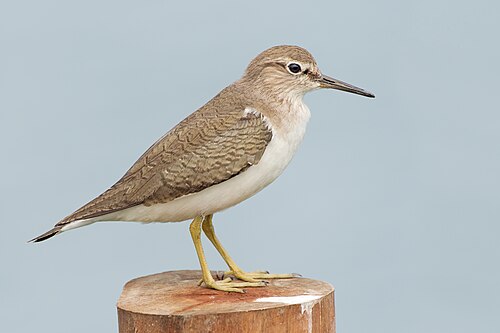
Common Sandpiper
Actitis hypoleucos

Green Sandpiper
Tringa ochropus
Global Distribution
Where this species is recorded worldwide. Restricted to human observations from 2019 onwards — the same kind of record and the same period the probabilities on this page are built from, so collar-tracking studies, camera-trap arrays and museum specimens are excluded. Around Santa Rosa that removes 5,924 GPS fixes from a handful of tagged jaguars.
where this species is recorded (GBIF density — it tracks where observers go, not how likely a sighting is) · parks where it occurs — tap a pin for the sighting probability there
Parks Where Found
| # | Park | Country | Daily sighting probability |
|---|---|---|---|
| 1 | Hortobágy National Park | 🇭🇺 Hungary | |
| 2 | Fertő-Hanság National Park | 🇭🇺 Hungary | |
| 3 | Kiskunság National Park | 🇭🇺 Hungary | |
| 4 | Tsavo East National Park | 🇰🇪 Kenya | |
| 5 | Wadden Sea National Park | 🇩🇪 Germany | |
| 6 | Bako National Park | 🇲🇾 Malaysia | |
| 7 | Białowieża National Park | 🇵🇱 Poland | |
| 8 | Yala National Park | 🇱🇰 Sri Lanka | |
| 9 | Camargue | 🇫🇷 France | |
| 10 | Biebrza National Park | 🇵🇱 Poland |