


Temminck's Stint
Calidris temminckii
- KingdomAnimalia (Animals)
- PhylumChordata (Chordates)
- ClassAves (Birds)
- OrderCharadriiformes (Shorebirds and Allies)
- FamilyScolopacidae (Sandpipers and Allies)
- GenusCalidris (Calidris Sandpipers)
- SpeciesCalidris temminckii (Temminck's Stint)
About the Temminck's Stint
Temminck's stint (Calidris temminckii) is a small wader native to the Old World. This bird's common name and Latin binomial commemorate the Dutch naturalist Coenraad Jacob Temminck. The genus name is from Ancient Greek kalidris or skalidris, a term used by Aristotle for some grey-coloured waterside birds.
Within the genus Calidris, Temminck's stint is most closely related to the long-toed stint (Calidris subminuta). Temminck's stint is one of the species to which the Agreement on the Conservation of African-Eurasian Migratory Waterbirds (AEWA) applies.
These birds are very small waders, at 13.5–15 cm (5.3–5.9 in) length. They are similar in size to the little stint (Calidris minuta) but shorter legged and longer winged. The legs are dull yellowish or brown, and the outer tail feathers white, in contrast to little stint's black legs and grey outer tail feathers.
This is a rather drab wader, with mainly plain brown upperparts and head, and underparts white apart from a darker breast. The breeding adult has some brighter rufous and/or blackish mantle feathers to relieve the generally undistinguished appearance. In winter plumage, the general appearance recalls a tiny... Wikipedia →
Closest Relatives at Camargue

Dunlin
Calidris alpina

Little Stint
Calidris minuta

Ruff
Calidris pugnax

Sanderling
Calidris alba

Curlew Sandpiper
Calidris ferruginea

Red Knot
Calidris canutus

Broad-billed Sandpiper
Calidris falcinellus

Eurasian Curlew
Numenius arquata

Common Redshank
Tringa totanus

Common Greenshank
Tringa nebularia
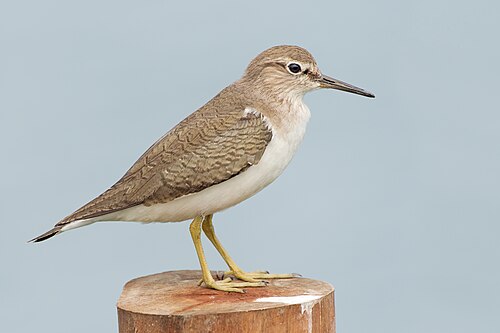
Common Sandpiper
Actitis hypoleucos

Green Sandpiper
Tringa ochropus
Global Distribution
Where this species is recorded worldwide. Restricted to human observations from 2019 onwards — the same kind of record and the same period the probabilities on this page are built from, so collar-tracking studies, camera-trap arrays and museum specimens are excluded. Around Santa Rosa that removes 5,924 GPS fixes from a handful of tagged jaguars.
where this species is recorded (GBIF density — it tracks where observers go, not how likely a sighting is) · parks where it occurs — tap a pin for the sighting probability there
Parks Where Found
Quick answers
What are the chances of seeing a Temminck's Stint in Camargue?
Under 5% of wildlife watchers report a Temminck's Stint sighting in Camargue, based on 14 verified sightings from GBIF citizen-science data.
When is the best time to see Temminck's Stint in Camargue?
August has the highest sighting rate for Temminck's Stint in Camargue in our monthly data.