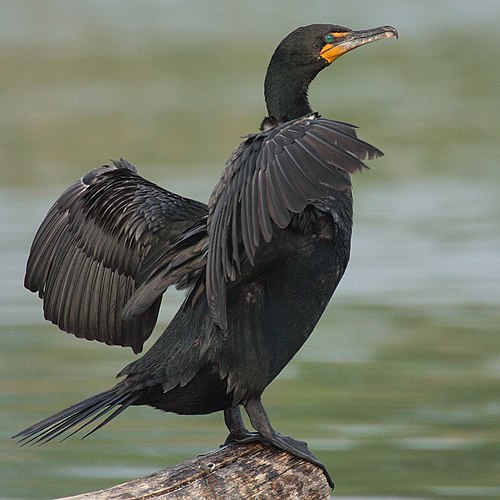

Double-crested Cormorant
Phalacrocorax auritus
Silhouette: Andy Wilson · PhyloPic
- KingdomAnimalia (Animals)
- PhylumChordata (Chordates)
- ClassAves (Birds)
- OrderSuliformes (Gannets, Cormorants, and Allies)
- FamilyPhalacrocoracidae (Cormorants and Shags)
- GenusPhalacrocorax (Typical Old World Cormorants)
- SpeciesPhalacrocorax auritus (Double-crested Cormorant)
About the Double-crested Cormorant
The double-crested cormorant (Nannopterum auritum) is a member of the cormorant family of water birds. It is found near rivers and lakes and in coastal areas and is widely distributed across North America, from the Aleutian Islands in Alaska down to Florida and Mexico. Measuring 70–90 cm (28–35 in) in length, it is entirely black except for a bare patch of orange-yellow facial skin and some extra plumage that it exhibits in the breeding season when it grows a double crest in which black feathers are mingled with white. Five subspecies are recognized. It mainly eats fish and hunts by swimming and diving. Its feathers, like all cormorants, are not waterproof, and it must dry them out after spending time in the water. Once threatened by the use of DDT, the numbers of this bird have increased markedly in recent years.
The double-crested cormorant was described by René Primevère Lesson in 1831. It was formerly classified in the genus Phalacrocorax, but a 2014 study supported reclassifying it and several other American cormorant species into the genus Nannopterum. The IOC followed this classification in 2021.
Its scientific genus name is derived from the Greek words νᾶνος... Wikipedia →
Recent sightings of Double-crested Cormorant in Celestún Biosphere Reserve
LIVEiNaturalistClosest Relatives at Celestún Biosphere Reserve


Global Distribution
Warmer areas are where this animal is recorded most often.
Parks Where Found
Quick answers
What are the chances of seeing a Double-crested Cormorant in Celestún Biosphere Reserve?
About 70% of wildlife watchers report a Double-crested Cormorant sighting in Celestún Biosphere Reserve, based on 1,477 verified sightings from GBIF citizen-science data.
When is the best time to see Double-crested Cormorant in Celestún Biosphere Reserve?
January has the highest sighting rate for Double-crested Cormorant in Celestún Biosphere Reserve in our monthly data.