


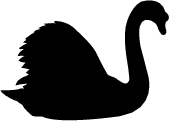
Black Swan
Cygnus atratus
Silhouette: An Ignorant Atheist · PhyloPic
- KingdomAnimalia (Animals)
- PhylumChordata (Chordates)
- ClassAves (Birds)
- OrderAnseriformes (Waterfowl)
- FamilyAnatidae (Ducks, Geese, and Swans)
- GenusCygnus (True Swans)
- SpeciesCygnus atratus (Black Swan)
About the Black Swan
The black swan (Cygnus atratus) is a large waterbird, a species of swan which breeds mainly in the southeast and southwest regions of Australia. Within Australia, the black swan is nomadic, with erratic migration patterns dependent on climatic conditions. It is a large bird with black plumage and a red bill. It is a monogamous breeder, with both partners sharing incubation and cygnet-rearing duties.
Black swans can be found singly, or in loose companies numbering into the hundreds or even thousands. It is a popular bird in zoological gardens and bird collections, and escapees are sometimes seen outside their natural range. The black swan was introduced to various countries as an ornamental bird in the 1800s, but has managed to escape and form stable populations.
This bird is a regional symbol of both Western Australia, where it is native, and the English town of Dawlish, where it is an introduced species. Described scientifically by English naturalist John Latham in 1790 as Anas atrata, the black swan was later placed into the genus Chenopis. In 1997, the species was placed in the genus Cygnus, in the subgenus Chenopis. The species is monotypic. Wikipedia →
Recent sightings of Black Swan in Daintree National Park
LIVEiNaturalistClosest Relatives at Daintree National Park

 Raja Shelduck
Radjah radjah

Pacific Black Duck
Anas superciliosa

Spotted Whistling-Duck
Dendrocygna guttata

Wandering Whistling Duck
Dendrocygna arcuata

Grey Teal
Anas gracilis

Green Pygmy-Goose
Nettapus pulchellus

Mallard
Anas platyrhynchos

Chestnut Teal
Anas castanea

Plumed Whistling Duck
Dendrocygna eytoni

Pink-eared Duck
Malacorhynchus membranaceus

 White-eyed Duck
Aythya australis

Australasian Shoveler
Spatula rhynchotis
Global Distribution
Warmer areas are where this animal is recorded most often.