

Green-backed Twinspot
Mandingoa nitidula
Silhouette: Sheatherius · PhyloPic
- KingdomAnimalia (Animals)
- PhylumChordata (Chordates)
- ClassAves (Birds)
- OrderPasseriformes (Perching Birds)
- FamilyEstrildidae (Waxbills and Allies)
- GenusMandingoa
- SpeciesMandingoa nitidula (Green-backed Twinspot)
About the Green-backed Twinspot
The green-backed twinspot or green twinspot (Mandingoa nitidula) is an estrildid finch found in many parts of Sub-Saharan Africa. The IUCN has classified the species as being of least concern. The green-backed twinspot has four sub-species:
Mandingoa nitidula chubbi Mandingoa nitidula nitidula Mandingoa nitidula schlegeli Mandingoa nitidula virginiae The green-backed twinspot inhabits lowland moist forests of the tropical region. It may also be found in grassland and shrubland habitats.
Males are distinguished from females by their bright red facial feathers. Females have an olive-green face and darker (almost black) beak. The green backed twinspot prefers its privacy in regards to breeding. Males in the breeding season will raise their heads, looking straight up while "dancing" on the perch next to the female, moving in a side-stepping fashion. The female, if receptive, will crouch down and point her tail to the male. Green backed twinspots tend to pair with one female and care for her and the young while breeding. Up to four eggs are laid about five days after mating, usually one daily. The female will go in and out of the nest frequently... Wikipedia →
Recent sightings of Green-backed Twinspot in iSimangaliso Wetland Park
LIVEiNaturalistClosest Relatives at iSimangaliso Wetland Park

 Black-tailed Grey Waxbill
Estrilda perreini

 Bronze Mannikin
Lonchura cucullata

 Pink-throated Twinspot
Hypargos margaritatus

Brown-backed Munia
Lonchura nigriceps
Black-and-white Mannikin
Lonchura bicolor

Blue-breasted Cordonbleu
Uraeginthus angolensis
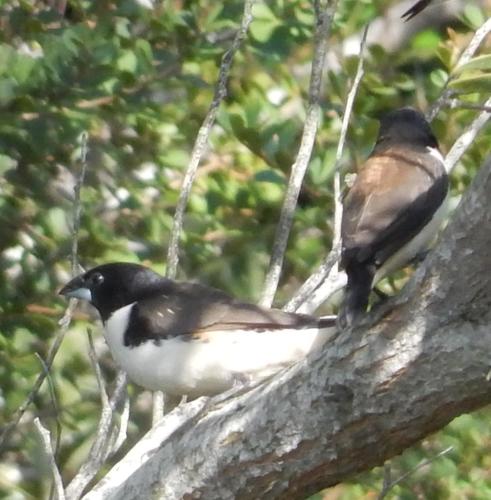
Magpie Mannikin
Lonchura fringilloides

Jameson's Firefinch
Lagonosticta rhodopareia

Green-winged Pytilia
Pytilia melba

Orangebreast
Amandava subflava

African Firefinch
Lagonosticta rubricata

Common Swee Waxbill
Coccopygia melanotis
Global Distribution
Warmer areas are where this animal is recorded most often.
Parks Where Found
| # | Park | Country | Daily sighting probability |
|---|---|---|---|
| 1 | iSimangaliso Wetland Park | 🇿🇦 South Africa | |
| 2 | Bwindi Impenetrable National Park | 🇺🇬 Uganda | |
| 3 | Arusha National Park | 🇹🇿 Tanzania | |
| 4 | Kibale National Park | 🇺🇬 Uganda | |
| 5 | Semuliki National Park | 🇺🇬 Uganda | |
| 6 | Virunga National Park | 🇨🇩 Democratic Republic of the Congo | |
| 7 | Tsavo East National Park | 🇰🇪 Kenya | |
| 8 | Tsavo West National Park | 🇰🇪 Kenya | |
| 9 | Kruger National Park | 🇿🇦 South Africa | |
| 10 | Gorongosa National Park | 🇲🇿 Mozambique | |
| 11 | Mikumi National Park | 🇹🇿 Tanzania | |
| 12 | Kafue National Park | 🇿🇲 Zambia | |
| 13 | Hluhluwe-Imfolozi Park | 🇿🇦 South Africa | |
| 14 | South Luangwa National Park | 🇿🇲 Zambia | |
| 15 | Akagera National Park | 🇷🇼 Rwanda | |
| 16 | Lake Mburo National Park | 🇺🇬 Uganda | |
| 17 | Murchison Falls National Park | 🇺🇬 Uganda | |
| 18 | Nyungwe National Park | 🇷🇼 Rwanda | |
| 19 | Queen Elizabeth National Park | 🇺🇬 Uganda | |
| 20 | Serengeti National Park | 🇹🇿 Tanzania | |
| 21 | Ngorongoro Conservation Area | 🇹🇿 Tanzania | |
| 22 | Masai Mara National Reserve | 🇰🇪 Kenya |
Quick answers
What are the chances of seeing a Green-backed Twinspot in iSimangaliso Wetland Park?
About 10% of wildlife watchers report a Green-backed Twinspot sighting in iSimangaliso Wetland Park, based on 136 verified sightings from GBIF citizen-science data.
When is the best time to see Green-backed Twinspot in iSimangaliso Wetland Park?
May has the highest sighting rate for Green-backed Twinspot in iSimangaliso Wetland Park in our monthly data.